Monday, May 18, 2009

The Green Yonder


[Image: Photo by Lubos Pavlicek/CTK/AP.]

You may have read a few months ago the US began removing some of the street barriers that have propped up Baghdad’s security on a stilted network of blast walls and checkpoints for years, since—citing improved security—the Iraqi government is aiming to open all of the capital’s streets by the end of the year. As mentioned in this article, removal of the barriers is linked to “a security pact signed with Washington in November that requires US forces to withdraw from all cities and major towns by June 30”, (which some say is looking less likely already), “and from the country as a whole by the end of 2011.” We’ll see.
At the peak of the sectarian violence 88 streets were closed in Baghdad, we are told, and if the article is accurate, the government has already reopened 75 percent of them. However, reading on officials also state that many of the “the walls and T-wall anti-blast barriers” would still be kept in tact while the Green zone itself, which houses the Iraqi government and the US Embassy, will remain completely barricaded.
In Ghaith Abdul-Ahad’s 4 part video series for the Guardian -- City of Walls -- he traces the maze of concrete slab seemingly dropped from the sky into Baghdad to keep separate the Sunnis and Shiites, splicing neighborhoods and highways in half, and given how pervasive these walls still are all around the city it’s tough to imagine – despite the roads being opened – that Baghdad is getting on any kind of reunification track.
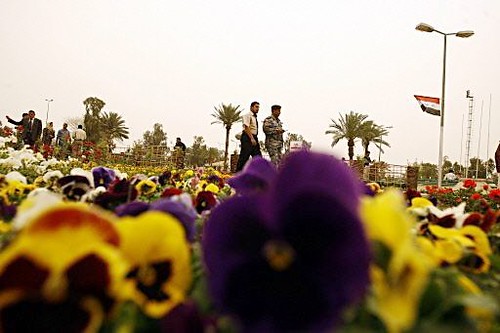

[Image: Blooming Iraq holds international flower festival/AP.]

Recently, Baghdad hosted a flower festival open in the streets to show how safety conditions are changing. But, as you know, there’s been a terrible new rash of car bombings recently that have taken hundreds of lives in just days, showing how tenuous the situation still is.
Yet, we read in the New York Times, despite the violence and the continued presence of the walls (which we’ve written about here on Subtopia numerous times already) many of the neighborhoods – having once held “a prevailing attitude of can’t-be-bothered, as seen in the buildings that went unpainted, crisscrossed by tangled wires from generators and satellite dishes, or the bomb debris just left lying”; that “smelled always of generator diesel and often of dead dogs, which rotted by the roadside untouched for fear they hid an I.E.D.,”; and where any “splotch of green” was “covered with thick dust”; further, when “Iraq seemed a place painted in desolation, and decorated with despair” – many of these neighborhoods are now apparently being revived by a wave of small scale landscaping projects.
Today, “buildings and walkways are trimmed by meticulously cared-for flower beds, with laurel hedges in geometric shapes, and so many roses that the breeze is fragrantly cloying.” All over, the Times continues, “fountains have started to spout again after years of disuse.”
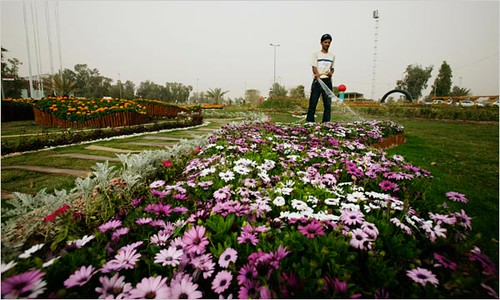


[Image: Christoph Bangert for The New York Times, Iraq’s False Spring]

While taking such a flowery brush stroke to Baghdad’s battered landscape the article (aptly titled Iraq’s False Spring) is careful not to paint too hopeful a picture. Forgive the bulkitude here:

“This is not at all to say that the ugliness of a war zone isn’t still present. It’s pretty hard to make towering blast walls into a thing of beauty, no matter how much paint is deployed. Mad Max fortifications are still often the rule. Hescos — antiblast protection consisting of big wire containers of rubble — defy all attempts at decoration. They’re just huge piles of dirt. There are still many areas of the city where no one seems to have figured out whose job it is to pick up the trash.

One such area is the Green Zone. There, a series of murals of Iraqi landscapes, each stretching over three to six sections of blast wall, have been moved to protect an Iraqi Army camp, with no effort to keep them in the right order. The result is a crane-size jigsaw puzzle.”

However, if French businessman Jean-Marie Zimmermann has his way he will replace many of these concrete walls with trees and bushes and make the Green Zone truly green, he told the media recently.
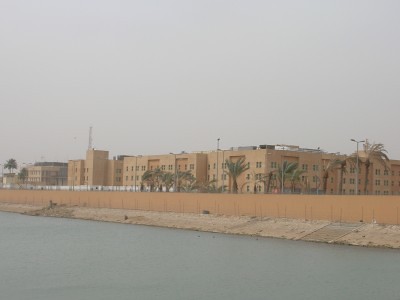


[Image: The New Embassy Complex in Baghdad, Iraq. Photo via Sharon Weinberger]

Zimmermann works for Sinnoveg, “a 420-hectare nursery in eastern France” that develops "natural defensive weaved hedges" and “walls made from tightly bound thorny plants,” many of which have already gone to securing high profile sites, like “a nuclear research center outside Paris,” for example, “a juvenile detention centre, train stations and airports.”
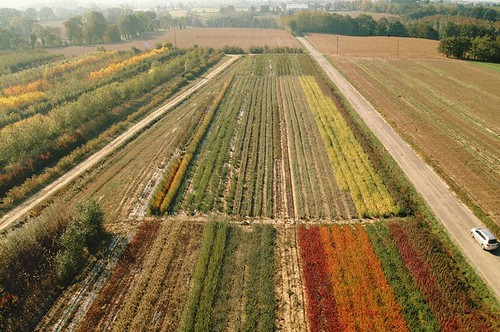
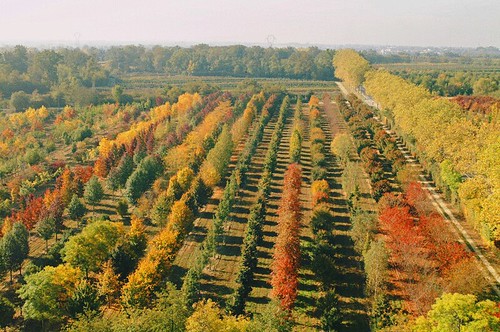

[Images: Tree Nurseries Daniel SOUPE.]

Apparently, the company has patented its defensive line of woven organic fences and is the first to propose using these types of natural walls at such a scale.
Speaking about the Green Zone:

"This is the kind of place where we can provide protection. We can remake Baghdad as a city focused on nature, ecology and the environment, with a new concept of security," he (Zimmermann) says.

The principle is simple: plant a row of thorny trees and bushes 80 centimetres (32 inches) apart and weave the branches together. As the plants grow they form a dense and razor-sharp hedge that within three years can reach a height of six metres (20 feet).

Zimmermann said traditional barbed wire, tyre spikes, sensors and even metal barriers can be placed within the hedges -- an invisible back-up layer of security.

"A tank can go through but not a truck," he says.

Not really sure, but sounds to me like just another green-washed marketing tactic to get a big government contract, and sell the notion that anything green automatically equates to better no matter how shallowly “green” may even be defined (is weaved foliage in conjunction with other barriers really more green?); this also strikes me as ignoring the fact that simply greening the barriers doesn’t do anything to work away the need for them in the first place. In fact, it probably only helps cement the opposite: which is to say, masking the barriers will only probably contribute to a greater environmental acceptance of them in the long run and therefore help to sell their permanence, help to sell barriers in a more pleasant form, and thus might play into a more long term swell of Baghdad’s false sense of security, adding to negligence of pressing strategies and efforts required to truly work towards a situation where barriers no longer exist. You could argue greening the barriers might lead to greater danger in the long run, by deferral.
But, to be fair, could the these green barriers slowly replace the current ones, and if so could they help lead to a removal of all barriers in the end, which would include these same green things themselves? Maybe. But, simply substituting barriers in various forms means nothing to me.
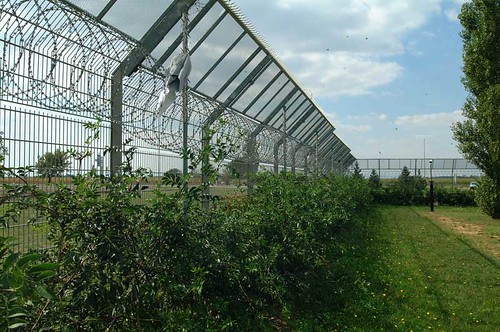
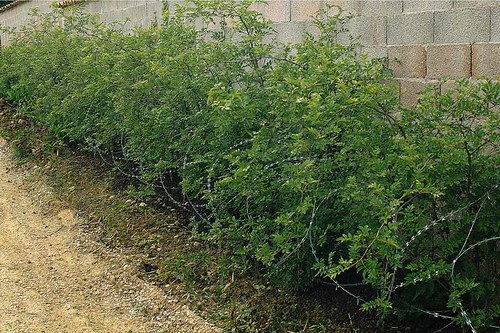

[Images: Courtesy of Sinnoveg.]

Still, it might be interesting to dabble in what could happen if this traveling fortress-scaper gets to plant his heavy-duty strain of anti-terrorist blast trees and weave a crown of impenetrable hedges around the Green Zone.
Say, over the course of several weeks Sinnoveg rolls through Baghdad in a tight caravan of armored trucks. A couple of which are covered in thick grasses and bristling shields that go darting down the road like two giant earth covered couches on wheels in a surreal advertisement of their product.
Onboard a few are bundles of various trees stacked upon one another like a bed of precious missiles. Inside other trucks huge mattress-sized divots of crocheted foliage are hauled that will eventually be knitted together by a catalog of spooled root systems following behind them. Dozens of smaller pick-ups zip to the front and then to the back again with carpet rolls of specially grown sod and extraordinarily long and flexible coils of braided branches and treated sea kelps. Steady in the middle of the caravan military escorts move semi-transparent boxes the size of refrigerators cut for oxygen with bright green ferny tentacles ever so slightly poking through them -- they retract going over bumpy roads. The whole thing is a mysterious convoy of mobile greenhouses and nurseries scooting past Baghdad’s rubbled streets in a sunlit blur.
In no time at all dozens of crews operating remote-controlled weaver-bots with interchangeable grapplers manage to drape the entire Green Zone’s heavily fortified perimeter in a terrestrial curtain like some old school camouflage tactic. From outside the zone this mangy green wall looks like a sub-natural island rising up from the battle encrusted core of urban Baghdad. A new Emerald City. An unihabitable island. Even though some sections of T-wall are removed many simply vanish behind the dense imbrications of unraveled hedge-walls and strategically planted trees that blow and settle into place all on their own like a great curtain being shook by a invisible hand – it instantly comes to life. It’s as if a militarized wreath the size of a small city bioengineered for war is placed around the Green Zone, the only thing missing from these massive grafts of vegetation are small populations of black-chinned hummingbirds, roboticized wasps and atomic desert butterflies, a few experimental DARPA-operated tree squirrels and monkeys, and perhaps a no man’s land strip of fallen dates and olives, pistachios and kamah truffles buried under rare patches of fence grass along the outside of the tree walls’ now excessively vibrant border.
At first, everything looks hunky dory. Suddenly, a flase spring is in the air as if the Green Zone has been made a halo of photosynthetic wonder. Fragrant with intrigue of far-off gardens, the attitudes of embassy personnel and Iraqi interior working behind these lush enclosures (which have been green-guarded on both sides) are noticeably cooperative and chipper. Productivity levels spike briefly marked by the curtain’s sudden bloom. Invited by this refreshing circular arboretum everyone spends considerably more time outside sauntering along its tropical walkways where perfumes of hybridized barks and woods and floral blossoms are addictively inhaled over coffee breaks and Subway sandwiches, while the avenues the other side of the green curtain (despite being heavily patrolled) slowly fill with people from all over the city flocking to check out the Green Zone’s living security fence; it quickly becomes a very popular public attraction.
Food stalls pop up. Informal literature is distributed explaining some of the exotic horticulture. New flowers end up inside people's homes. In short, the green curtain seems to have won over everyone.
But, as months pass through an oddly schizophrenic season dredged in torrential rains, abnormal wind chills coupled with ballistic heat spells, and a particularly violent sand storm that swarms Baghdad for a week leaving thousands plagued by wretched allergies, the fertile shield continues to grow, quite wildly in some parts in fact – so much so the entire thing looks weirdly out of harmony with itself, like a gangly teenager struck by uneven growth spurts in his limbs – the project soon requires incessant pruning in order for Sinnoveg to maintain its mastery of it.
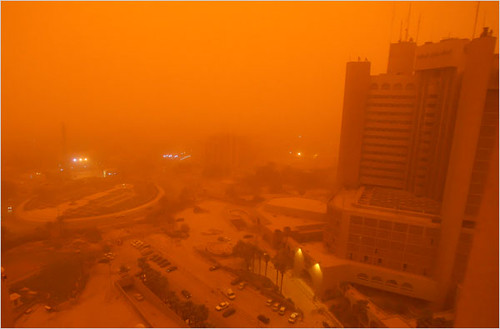

[Image: Much of central Baghdad was barely visible through a thick dust storm that blanketed Iraq's capital. Three bomb attacks killed 34 people and wounded dozens more in Iraq on Monday. Photo: Hadi Mizban/Associated Press.]

But the pruning is only good for so long. Propagating at frightening pace, the curtain first chokes off a couple key checkpoints into the Green Zone so they cannot be used again, at least until Sinnoveg’s emergency team of hedge techs can be flown in to perform serious amputations of the green wall. By the time they get there however the bulk of the hedges have grown far beyond any anticipation and Sinnoveg reluctantly admits they’re a bit unprepared to deal with the curtain’s manic growth.
Meanwhile, Baghdad hacks through an allergic disaster sneezing violently and coughing up little sacs of blood, rupturing septums with incessant snorts and clogged bellows, flinging constellations of slime everywhere from their nostrils while simmering winds keep it all astir.
Zimmermann’s hedge techs try to come out at first every month, then every week to inspect and saw away the excessive growth, but even they cannot believe their eyes. In the words of one supervisor, “the hedges have taken on more than a life of their own, they’ve gone completely mad – I think they’re possessed!” – they're no longer held in check by the harsh climate Sinnoveg anticipated making their maintenance work much easier.
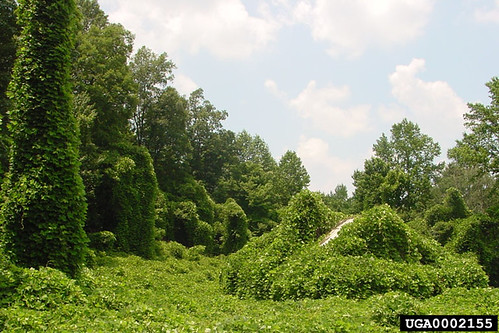

They take up full-time residence in the Green Zone bunking in old US Army barracks and leftover trailers used to house American bureaucrats before those folks were shifted into blast proof apartments. But, even working 'round the clock through delirious shifts of nocturnal overtime they can’t keep the tree walls and monster hedges down. No matter how much they hack and haul away the missing volumes usually replenish within a couple of days and then grow even more. And the discarded greenery always has a way of going missing. Unless they burn it over permanent fires that emit strange fumes the piles either blow away or just “magically slip off somewhere,” one worker is overheard saying. “It’s the strangest thing. I swear this stuff slithers like a bed of snakes.”
Another employee claims to watch a set of branches cultivate more than a foot overnight prompting the installation of surveillance cameras to monitor the curtain’s late night growth cycles. But the hedges soon crush them and they become irretrievable. “The climate here is having an incredible effect on the hedges, no one ever expected them to take off like this, certainly not here,” Sinnoveg’s chief botanist says at a press conference. Not only is everything spurting uncontrollably, he goes on to explain, but the entire thing has its own intelligence of weaving itself together in far more intricate and formidable patterns than Sinnoveg’s engineers can ever dream up. Unsure of what the hell to do the engineers simply take pictures and notes.

[Image: By Paul DeCelle.]

By the end of winter most of the entry points to the Green Zone are completely stitched shut by feral vines, and Sinnoveg’s boys are more or less beaten down. Their weaver-bots working furiously in reverse all burn out. Their tools prove completely ineffective, and their ideas run abundantly low.
Soon, one by one all of the checkpoints are sealed by this creeping drapery so impromptu emergency bridges are slung over canopies extending 30 to 50 feet high in some areas, where bureaucrats climb like nauseated refugees fleeing their own compound.
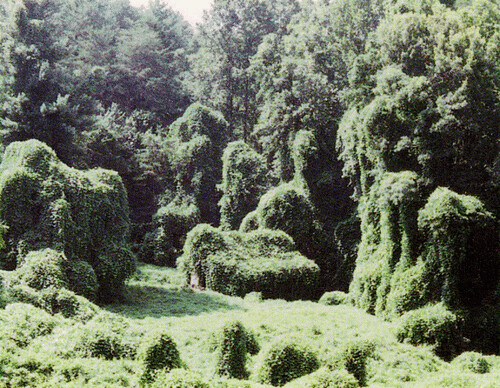

With the help of the US Army Sinnoveg tries to dig a couple of tunnels below the curtain but the roots are tangled so deeply underground they are as impenetrable as the woven fences above.
Most people remain inside the zone even more than they already do for fear the hedges will grow too much in a single day and they may not be able to get back in over the makeshift bridges later. Of course, all of this prompts major security concerns and Green Zone patrols are beefed up on the highest alert while new waves of tension ripple through out the city.
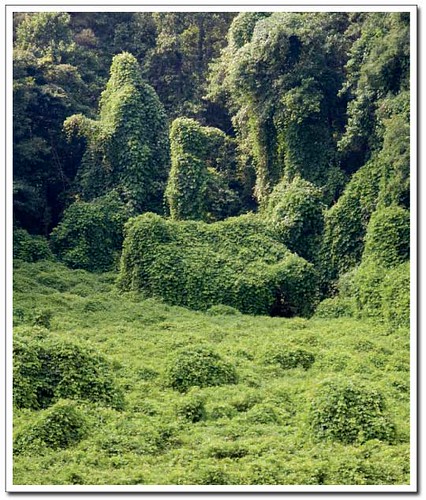

Zimmermann now dangles in a thicket of bad publicity and like the Green Zone is going under fast. The Iraqi government calls in a special team of scientists to investigate the situation who immediately notices the Tigris’ River's water levels dropping frighteningly fast. Not only is the Green Zone’s new ecological upgrade completely taking over the compound but it is leaching the ancient water source in staggering amounts. More mild pandemonium sets across the city where random green parks have begun to spring up, strange patches of fresh growth in very unassuming places. Wandering gardens. Exotic alleyway flowerbeds. The city collectively sneezes.
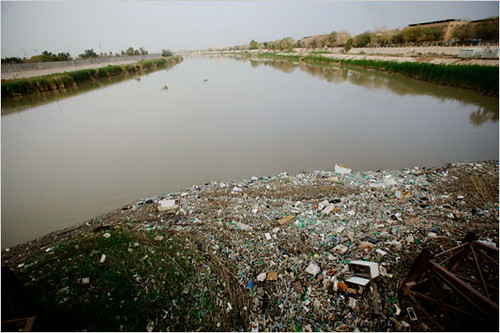

[Image: Garbage on the Tigris By Christoph Bangert.]

Operating inside the Green Zone is a logistical nightmare made worse by the fact that to completely abandon it at this point is not even possible because there’s no way to get everyone out safely without pulling off a helicopter mission military officials say would be too dangerous because it would expose everyone to insurgent attacks.
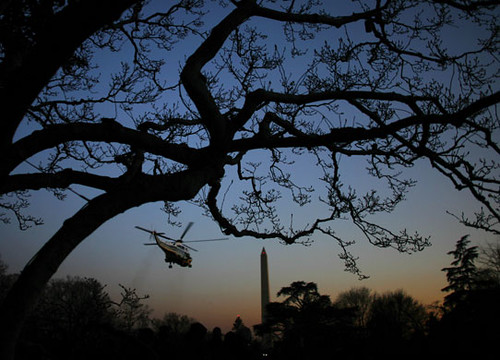

[Image: From the lawn of the White House. Photograph: Jim Young/Reuters.]

Essentially, they're locked in. Food products and critical items are broken down into a continuous flow of smaller deliverables that have to be kept moving through a kind of stealthy aerial smuggling operation. All the while the mutant tree walls continue to grow and even change shape so they look less like walls and more like mounds leftover from ancient builders; the great wreath soon becomes a miniature mountain range ringing the Americans inside as if it were a green mustached volcano mouth. From the rest of Baghdad’s perspective, a jungly cloud has swept over the imperial zone and turned something heinously historic into an uninhabitable wild island.
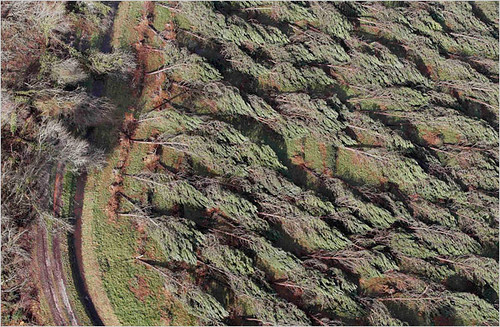

[Image: Photo: Regis Duvignau/Reuters.]

Where once a space between the Embassy and its own inner ring of walls functioned as a separate layer of security or as a temporary promenade with little shops dispersed along side other outdoor spaces, the rabid hedges and sidewinding green tentacles completely consume this zone and begin to latch onto the Embassy structures themselves; in some cases baby hedges hatch from inside the buildings. Offices fill with strange mosses, hellish tufts of weeds break through concrete walls into the shiny new dining facility, the America Club is quickly mildewed by funky algaes, and the hospital turns into an oversized salad bar. Hedges soon sprout everywhere, inside closets, under diplomatic beds, the embassy becomes a Sinnoveg archive of hedges.
With their perimeter fatally compromised the US Army starts to panic about insurgents climbing over the mounds and through the haunted trees to inflict harm on the stranded embassy personnel. Yet, most of the personnel claim they are trying to escape from the zone not because they fear that sort of violence but because they feel “stalked by the green curtain.”
And there might be some truth to that. Not one supposed insurgent ever bothers to climb over this incredible concentric forest, especially not once the media announces that a couple US soldiers assigned to monitoring a temporary passage in the North West of the zone have disappeared and their bodies not yet found by the army, which of course triggers additional reports of Iraqi taxi drivers going missing near the curtain, and even some small children.
Baghdad’s violence is actually rather quiet during this whole ordeal, ironically enough. It’s simply more urgent to watch the nightly news reports or even go see firsthand these rabid and viral gardens flourish in the heart of the city and claim the compound’s brutal architecture than to think about neighborhood violence. The gardens are forcing everyone out of the Green Zone like rats from a flooded hole, and the site of this alone has Baghdad in its grips and blowing their noses.

Months grow thick and Zimmermann’s arrogant claim to make the Green Zone truly green haunts him across newspapers all over the world. But he refuses to leave and takes up a position atop a watchtower that pokes up from the center of the compound where he continues to order his scrambling mad technicians, at least those who have stuck around. At one point he instructs them to bail from their own car bombs packed with incendiary explosives at the heathen hedges, hoping this will blast through them. But the hedges are inviolable and the great curtain merely shakes the burning vehicular corpses off before consuming them. His men try everything from flamethrowers and ultrasonic weapons to high-density lasers to suppress the hyper lattice of stems and green cords cinching in on them from every angle, but only makes it all grow back and sew itself together with vengeance.
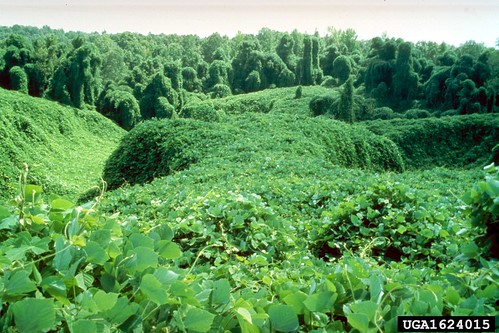

As we said, all this time the political violence stops but few notice. Instead, the Americans manage to scramble to random corners of the city waiting for airlifts to other camps in the region while a local filmmaker surveys the scene on the ground with camera crews eager to capture the final days of the main palaces of Saddam Hussein – and now the imperial bunkers of the American regime -- as they are finally ready to be overtaken by an incredible surge of nature, to be toppled by no man but millions of mice and insects and tiny birds instead that suddenly spawn to pick apart the hubris remains of Empire’s overreach before everything in the zone is completely devoured and the cradle of civilization is turned into a swath of insatiable "greenery."
For weeks Baghdad’s anxious crowds gather around the rough green edges to watch the modern fortress buried over. What seemed impossible years ago takes Baghdad by storm in just a few weeks. The film crews race around the brambly mess daring into it to get footage of the final days of the elegant marble building used by the Iraqi Governing Council before it succumbs to an army of woven knots and cables, prowling nooses, and the thuggish push of the Sinnoveg's rogue hedges.
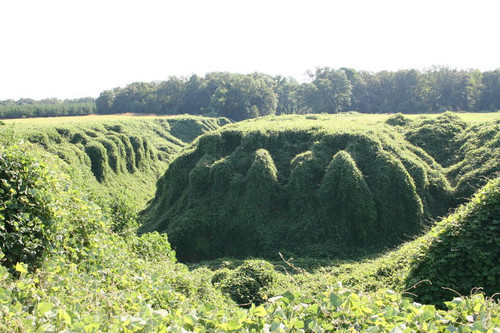
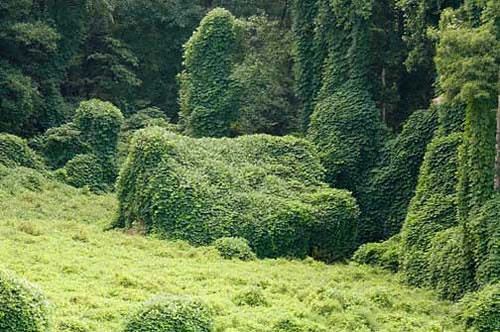


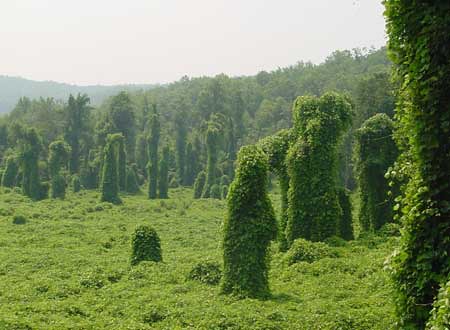
On televisions all over people watch the verdant cocooning of tin trailers and the slow grassy ground invasions of abandoned military camps and feeble barracks wilting under the vines and being consumed overnight like worthless shelter carcasses. Lightweight tent structures and abandoned vehicles drown in thorny thickets, while an empire of sprawling kudzu ivy spreads over the entire site and covers it and roughly all 30 or so buildings in the Zone so the media begins referring to a “green blanket” rather than “the green curtain” it once used to be.
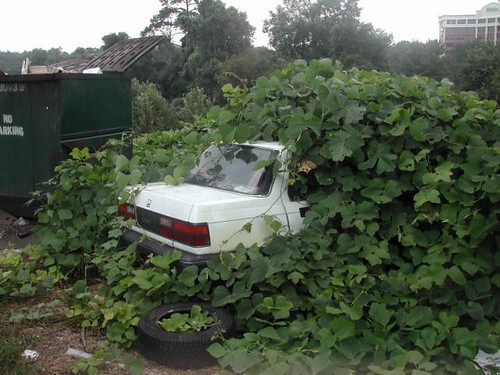
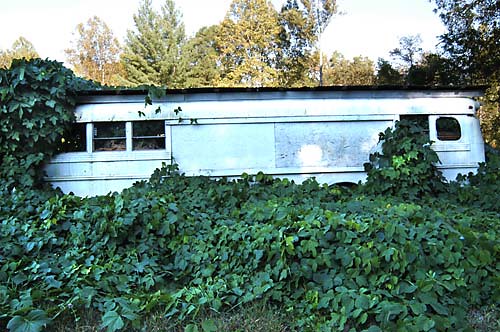

100 acres of urban space suddenly turned into an orgying jungle spiked with modern ruins; the crowned jewel of empire now a giant bomb crater filled in instantly by fresh green earth; call it a post-imperial Oz or the greatest Crack Garden ever spawned, it’s the world’s “ultimate gated community” torn down by a spontaneous green yonder.
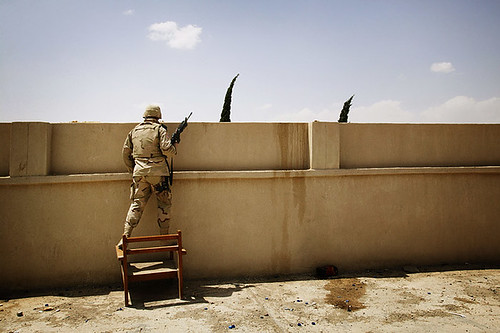

[Image: Photo by Christoph Bangert.]

Cameras hang from balloons and relay shots of the complex’s apartment buildings and the hospital disappearing inside layers and layers of green bubble wrap, with one last blocky concrete islandtop resisting the tree lines upon which Zimmermann stands on a wobbly chair. Looking down upon the green yonder with a tormented grin, a fiendish vortex of ferny tentacles lap at the base of his pedestal. He looks out over Baghdad and sees it besmirched by wicked plots of strewn greenery now. Lilypads swell in his eyes.

Monday, May 04, 2009

Peripheral Milit_Urb 29


[Image: NYT / Baghdad: City of walls.]

Iraq and Afghanistan, sittin’ in a tree….

Baghdad: City of walls // Divided Cities // A Year in Iraq and Afghanistan // Pentagon Rethinks Old Doctrine on 2 Wars // The Economic Cost of War in Iraq and Afghanistan // 283 Bases, 170,000 Pieces of Equipment, 140,000 Troops, and an Army of Mercenaries: The Logistical Nightmare in Iraq // Withdrawal. // U.S. starts to leave key Iraq bases // Cost of war in Afghanistan soars to £2.5bn // Battle Over Bases


[Image: Afghanistan's Perilous Roads: Allies Struggle to Find Safer Supply Routes.]

Infrastructural Inhibitors/Enhancers

For War Supply Routes, U.S. Looks Even in Iran // US finds new Afghan supply route // Al Qaeda builds a 'Shadow Army' // // The Saharan Conundrum // Secret U.S. Unit Trains Commandos in Pakistan // An Anti-Iranian Enclave in Iraq Fights to Stay // Pinned Down, a Sprint to Escape Taliban Zone // In remote Afghan valley, a rare peace sprouts with insurgents // Iraq's quiet healthcare crisis


[Image: Iraq’s Widows, NYT.]

Refugee'd to Death

Iraq's Invisible Refugees and Widows // Afghan Civilian Deaths Rose 40 Percent in 2008 // Afghan women who turn to immolation // The Most Pervasive Combat Injury Among U.S. Soldiers is Invisible -- and the Pentagon Has Tried to Keep it That // Forgotten Warriors: Injured war zone contractors fight to get care // Life in the world’s largest refugee settlement // Nearly 20,000 Murders in Iraq Since War's Start


[Image: Documenting the return of U.S. war dead.]

Why 10,000 Ugandans are eagerly serving in Iraq // The soldiers who can no longer fight // Donkey ‘suicide’ bombing is latest tactic against patrols


[Image: Babylon Ruins Reopen in Iraq, to Controversy.]

Touring it all in

Travelers, Your Tour Bus Is Boarding for Basra // No frills tourism - in Iraq // a baghdad shantytown // Afghanistan’s First National Park (Deep blue lakes) // Civilians Reassert Themselves in U.S. Foreign Policy // The Future of the Military -- Perhaps // Military embraces green energy // After the green economy, green security

Shock Doc in Effect

Empire Foreclosed // Americans Accused of Stealing Fuel in Iraq // Some U.S. troops tempted by reconstruction cash // Corruption Undercuts Hopes for Afghan Police // $1,000 for a kebab? Afghan villages fight corruption // Corruption and incompetence cripple Afghan reconstruction effort, say aid workers // Kellogg Brown & Root LLC Pleads Guilty to Foreign Bribery Charges and Agrees to Pay $402 Million Criminal Fine


[Image: Rebuilding Gaza _ world faces daunting challenge.]

Gaza

Israel Treated Gaza Like Its Own Private Death Laboratory // Once You See What Truly Happened in Gaza, it Will Change You Forever // Gaza case studies: Weapons use // Israeli limits stymie Gaza rebuilding // Pots of urine, feces on the walls - how IDF troops vandalized Gaza homes // Human Rights Group Demands a Freeze on West Bank Quarries // In ruins for 18 months, a Palestinian enclave languishes in disrepair // Homeless in Gaza // Actor Romola Garai visits a Syrian refugee camp // Palestine *lego-town to go ahead // In Village, Palestinians Face Gas With Rocks // Israel Breaks Up "Arab Capital" Events In Jerusalem // Israel's Dirty Secrets in Gaza: It Was Pure Murder // Israel Used Phosphorus to Torch Hamas Hideouts // Land of Ruins: A Special Report on Gaza's Economy // Barbed Wire in Bethlehem // Little hope in Gaza aftermath // Palestinian graffiti spreads message of peace


[Image: Chicago architects' big-boned border station wins national design award.]

Of Hermetic Impossibility

Newly Released Secret Memos Provide the Blueprint for Bush's Police State // Re-evaluation of National Security Ordered // Inheriting Halliburton's Army // ARCO discovery: Corporate Armies by PSJM // Detention Decisions

Emerald Corrections Building New ICE Detention Center in Mineral Wells // After Six Years, Still No Tamper-Proof Shipping Containers // New London Embassy // Drawing the void // Tribal Raids and Medieval Defenses // The Architecture of Instruction // BIDs Bring Down Crime


[Image: Anti-teenager “pink lights to show up acne”.]


Government draws up security strategy for London 2012 // Pub is closed by Monty Python grenade // Police warn that Britain faces summer of rage due to recession // Robot planes take to the skies // Black Hawks to train over Melbourne // Filling the Skies with Assassins // White House Apologizes for Air Force Flyover // US refuses to let jet into its airspace because it is carrying a journalist who criticizes US foreign policy

Armed America: Behind a broadening run on guns // U.S. Cities Increasing Use of Armed Mercenaries to Replace // California Towns Fight Back Against Justice Department Suit to Overturn Youth Protection Act that Bars Military from Recruiting Minors // Protests at the G20 summit // For Sale: Russia's 'Anti-Democracy Truck' // Spotlight Falls On Tactics Of Policing Protests // 'Locking down' Georgia's capital // G20 police blog boasts about a 'good kicking' a day after the death of Ian Tomlinson // Kettling: another special relationship // Masked Superheroes Patrol Cincinnati Streets // new criminals fight crime in Rio


[Image: My street in Gaza.]

CONFLICT SCAPES

WIRED FOR WAR: The Robotics Revolution and Conflict in the 21st Century // The Coming Swarm // ‘Cyberspace and Security: Issues and Concerns’ // Duo’s Second Prison Escape Embarrasses Greek Officials // Twenty Theses on the Subversion of the Metropolis // S.F. may crack down on 'flash mob' antics // Resource Hogs: Greening Prison Infrastructure // soft Tokyo // A Second 9/11 in Slow Motion // Infrastructure Dept.: Light Fight // Military Translators at War // Professors in the Trenches: Deployed Soldiers and Social Science Academics // UCLA researchers study social forces shaping human behavior during war // Academic lecture on the theory of war as conducted in Starcraft // Wars Abroad Continue at Home // Killings and Concentration Camps: A Colossal Humanitarian Tragedy is Underway in Sri Lanka and No One is Saying a Word // Military Futurism // GWOT, R.I.P. // U.S. Cities Vulnerable to Mumbai-Like Attacks // You are being lied to about pirates // Forget Star Wars. It’s Back To Colonial Warfare // On jumpy Israel-Lebanon frontier, a quiet drug war // Hey, Anderson Cooper -- Stop Stoking Racist Fears About Mexican Drug Cartels Invading U.S. Cities // Tibetan lama on trial for weapons charge in China // Typologies of Borders and Migration // The Image of the (Failed) City : Spillover


[Image: Forward Intelligence Teams.]

SURVEILLATOPIA

The architectural photographer as terrorist // NYPD's enforcement of non-existent subway photo-ban costing taxpayers a fortune in lawsuits // Britain's no-photographing-cops law: even the cops hate it // Police delete London tourists' photos 'to prevent terrorism' // NYPD Cuts Cops, Keeps Spycams for Terror Defense // Special Forces' Gigapixel Flying Spy Sees All // Landlord fights police plan for CCTV at pub // Did UCLA Profs Just Find Osama? Only if He's an Idiot // Using Crappy Geographic Methods to Not Find Osama bin Laden // Chicago Links Street Cameras to Its 911 Network // UK's top snoop gets finked out by her neighbours // FBI planting spies in U.S. mosques // FBI and American Muslims at odds // New Database Tells Big Brother You're Uninsured // Big Brother is watching your iPhone // Eyeball spy turns the tables on Big Brother // Behind the cameras // Our ears may have built-in passwords // What's in the Bag? 3-D Scanners for Airports // LIVE from the inside of a carry-on xray machine // Cell Phone Towers Pretending To Be Trees // Lights! Camera! Action! // Invisibility cloak edges closer


[Image: Airports Seek Thermal-Scan Solution to Swine Flu Spread.]

FBI Nabs Robbers With Google Map, Spycam Mashup // Google Wants You to Profile Yourself // Old Japanese maps on Google Earth unveil secrets // Google Street View does not breach privacy laws // Google Earth: The Desktop Treasure Hunter

Dr. Bob's Terror Shop // Clandestine defense hub prepares to open at UM // Oaxaca Mapping // Justice Dept. Reins in Surveillance Program // Emotional Cartography // The Road to Area 51 // U.S. Military Satellites


[Image: Danger Room, Air Force to Unleash 'Gorgon Stare' on Squirting Insurgents.]

INSIDE DANGER ROOM

Stimulus to Pay for 'Greening' of the Military // Scientist Looks to Weaponize Ball Lightning // Videogame Technology Helps With Disaster Planning // Tracking Down Gaza War's Deadly, Mysterious Cubes // Darpa Wants a Lab for Sim Afghanistans // Simulated Suicide for Laser-Training Troops // Mini-Bots, Missile Boats in Israel's Gaza Attack // Meet the CIA's Shrink // Inside the (Hypothetical) Somalia War Room // Feds Turn to 'Brain Music' to Boost Emergency Worker Performance // Military Bases Block Official Army Tweets


[Image: WWII internment camps part of park system.]

RESIDUAL LANDSCAPES

Brutalitaet in Stein // Albert Speer in Korea // North Korea Reopens Military Hot Line // Architecture During Wartime // British architect makes war-damaged Berlin's cultural heart whole again // Serbs ordered to pay for mosques // Paris liberation made 'whites only' // One Giant Step for Kazakhstan: The High-Flying Hopes of a Cosmodrome // War and Medicine exhibition at the Wellcome Collection in London // Photos from Pripyat, abandoned Chernobyl workers' town // Chernobyl 'shows insect decline' // Walking through the Dead Zone // The Forbidden Forest // Hanford Nuclear Reservation: A Look at the Nation's Most Polluted Nuclear Weapons Production Site // Images Unseen, Images Unknown // What Plane?

World Cup invitation brings down final part of Iron Curtain // Berlin Wall given a facelift as freedom painters return // Cold War haunts Armenian border // Cold War Bunker Becomes Modern Mansion // Art of Two Germanys, Cold War Cultures // Images of a Lost World: East Germany, Up Close and Personal // New Looks at the Fields of Death for Jews // Dubai's Lesson to America: How the Middle East's Shangrai La Became a Hell on Earth // American Stonehenge: Monumental Instructions for the Post-Apocalypse // Discover Kauai


[Image: The Feedback of Exile: Interview with Stephen Tourlentes.]

A ROOM FOR LEFTOVERS

Questioning Authority: A Rethinking of the Infamous Milgram Experiments // Inside Guantánamo Bay // Re-Landscaping the Slum // The Benefits of Nuking Chicago // Open Data: Shuttle Impacts From Space Junk // What's it like to live on a submarine? // Pilvi Takala works: Kulunestokokeilu // Abandoned Boeing 747 Restaurant (and Other Plane Conversions) // A fair cop: Policeman's 'perfect' blog wins Orwell prize // “Sacred Code” // Schneier on Security: Tweenbots // Company pulls plug on `Fallujah' video game

[Earlier peripherals ... 1 2 3 4 5 6 7 8 9 10 11 12 13 14 15 16 17 18 19 20 21 22 23 24 25 26 27 28]

Tuesday, April 28, 2009

On Archiving the Architectural Signatures of Torture


[Image: Inside the Secret Cellblocks of Abu Ghraib, A soldier-narrated tour of the detainee camp during its final days. (MoJo Video).]

"Finally, one of our senior NCOs went completely over the top and, in an honest moment, broke some of the tension by making fun of himself and those who called us heroes. As he led us on a ruck march, he shouted, "You are the lions of the desert! You are the scorpions of Iraq!" (Tony Lagouranis, from his book Fear Up Harsh: An Army Interrogator's Dark Journey Through Iraq.)

After watching these two videos taken by a US Army soldier on a stroll through the detention camps of Abu Ghraib “during its final days in 2006,” Mother Jones reports, “after the prisoners left but before it was torn down, and evidence of the camp was buried and burned,” it seems all the more urgent to think about how we can – or maybe more importantly – how we should archive the war on terror’s insidious brand of torture space. Were it not for critical artifact vaults unearthed from the past and handfuls of groundbreaking historic research, early evidence – and indeed our understandings – of torture might have been lost long ago.
If not for important web projects, maps, video libraries, traveling torture device exhibitions, novels, memoirs, survivor story based films, billboard art, gallery shows, installations, declassified government files, secret CIA file stashes, a few international trials, some scattered museums and off the beaten track site preservations around the globe (hell, one day they might even say if it weren’t for these Lego Toys, or this architecture studio whose assignment was to design a torture device!) the pale histories and butchered geographies of torture’s secret autobiography might have dissolved in a dark sea of popcultural obscurity inscrutably lost to the amnesiacal tendencies of our collective imagination.


[Image: Cut Loose. Roger Ballen, 2005, Via Prison Photography.]

I am reminded of a quote from Pete Brook, who runs the ever-increasingly amazingly archival blog Prison Photography, when commenting on the below radar work of photographer Roger Bellen (who has been producing images that are as stark and harrowing as the images of Abu Ghraib themselves since the 70's) and why the media pays him minimal attention:

"It seems the comparison is so glaring no-one has wanted to state it! Is it with guilt we accept Ballen’s work into an art aesthetic, and then stand with repulsed incertitude before the Abu Ghraib images? Much has been made of Ballen’s hypnotic work and his vortex of image and dis-logic. I wouldn’t suggest he is a mystic seer, but if some sort of visual, global Zeitgeist exists, I would suggest that Ballen tapped it. Few commentators have readily acknowledged this visual convergence. Why? Strange forces.

We have argued the ethics and presence of torture in non-photographic media, but have we failed to satisfactorily take up issues surrounding the aesthetics of torture in photography?"

Salient questions. Makes me wonder how much we digest torture through the art world, through media, through pulpified pornographications of B films and bad TV, politics, media, advertising, so much that we never taste the vile repulsion of torture's reality when faced with it? We might still gag, but not long enough to stop us from taking another bite. Perhaps we need to realize a Ballardian Attrocity Exhibition, a stark neutered world people can see firsthand and visit to wake them to the pathological and fictional defects rooted as failed promises in our normal landscape.


Though Obama released several incriminating memos on torture before brazenly telling us to just look away and see past them (past the blueprints of legalized torture!...just walk on by, he says - walk on by!), as empty as his act may prove in the end we at least have those documents now to refer to in the future. Like witness accounts and standby films, we have the ability to comb through them again and again for missed details, for future precedents and litigations.
And while we can still literally touch and grip ancient torture tools in our hands today, and even remake modern devices of electrocution, waterboarding, or assemble the audio speaker set-ups of musical torture for that matter if we need to for demonstration purposes, unless the sites themselves are stored in some way we cannot go back and situate torture outside the limited references afforded by lucky photos, miraculous videos, happen stance audio recordings, first hand accounts, hearsay, and other documents that can only offer a somewhat flat and framed perspective of the torture arena.


But torture isn’t only the action of torture, or a moment in time when torture happened, it is a space hatched from a very specific set of spatial circumstances and geographic contexts wherein less obvious narratives of torture reside in landscape, where horrible eternal memories are permanently spatialized within the fragile confines of a victim's psyche, where coded behavior of torturers themselves greases cogs of runaway power, where rampant scars in the law can be measured more closely.
That is to say, I suspect torture spaces (like all spaces do) resonate with their own meanings about the nature of torture, and help to reveal the spacio-political configurations that contain torture, reflecting extra-legal logics and political constructs of law that can be devised to shelter torture. Torture inside a vacuum (while still torture) may not be as damaging as torture in a tangibly real and memorabe place.


I’m obviously no historian or political scientist, but it appears the more we have tried to legally protect against torture the more we have enabled the law to be tortured itself, twisted to the point of legally bending to justify torture. Can we then use the sites of torture to deconstruct this process of how law becomes a form of detainee and made victim of torture itself, since the law is what is used to architect torture for the broken information gathering industry the war on terror requires? If torture space is the product of the politics of torture, how can this space be examined in order to dislodge these politics from our legal landscape?


Talk to a forensics expert and they’ll tell you there is an element to which the space itself is complicit with crime, to shield and cover acts of torture. In some cases, social theorists will blame spaces for crime. Crimes take place in designated spaces for various reasons, some far more obvious than others. Talk to a pyschotherapist and they’ll tell you how torture carves deep-wounded spaces of trauma in the victim’s mind so that specific characteristics of another physical space altogether can trigger traumatic memories in the survivor and thereby induce more trauma – the legacy of torture space never quits, you see.


As a spatial phenomenon I’m curious (and this might be a great question for David Gissen who presented at Postopolis! on ways of practicing architectural history and archive), how do we even go about considering the preservation strategies for something like torture space? What else is secretly stored within these nascent containers, and how could we encapsulate it?
At one point, Gissen was talking about preserving pollution as a possible future urban archive, or storing giant swaths of sky that would house the atmospheres of cities in their environmental states dozens or even hundreds of years ago. I mean, what if anything can the desert dust tell us about the American chapter on torture in Iraq? What about all of the debris, the discarded material that once stabilized the camp before it was taken down, what might we learn about the infrastructure of torture in those remains? Anyway, I've asked these same sorts of questions already in a previous post on the CMUs in Indiana and Illinois.


Torture is one of the grimmest and most unconscionable legacies of humankind, we could say it’s given real estate to some of the worst and most secretly kept crime scenes ever. Shouldn’t we then treat it as such and seek to create a spatial archive of torture for reference and as a model to further study the spatial ramifications of torture, the political encoding, the cubic effects of torture space on victims and the neighborhoods where torture is presumed to be taking place?
There is a relationship between space and torture which just seems so largely unexplored to me (as fearful as the prospect may be to look any further); like much of what we probably still don’t know about space phenomenon and spatial cognition as those subjects can be observed neuro-scientifically, we have probably only scratched the surface of bringing the architectural relevance of torture to bare on our legacy as a species.
Yet, in light of what I said about the law being the ultimate victim, should we avoid research into the psychological dimensions of torture space because that data will only be used to corroborate new legal mechanisms for future torture justification which seems to be the pattern? Of course not, I don’t think we can ever surrender to that notion. We should strive to learn, define and protect against torture as much as we can, all the more now, and then fight for protections in the law afterwards.


A more generic question could be: how might the sphere of architecture be used to help the international community continue to make light of torture and educate, not just for people today but more critically for those future generations who will wrestle with the tragedy of new torture and the cultural legacy of today’s? I know there are great efforts out there afoot to document the political, psychological and historic spectrums of it, but what is architecture's contribution towards this aim of capturing and scrutinizing torture itself.
In other words, could we use architecture in some manner to interrogate torture space itself, to put torture itself on trial, not only to raise awareness but as an under-explored means for identifying and cataloging further evidence of abuse, uncovering new research as it has been inscribed in torture space, etc.? Would building a perfect replica of Guantanamo Bay on an manmade island in the SF Bay next to Alcatraz that could be toured help the American public in any way to think about the importance of pressuring our politicians to prosecute the architects of torture? If the presence of Alcatraz is any indication of how we respond culturally to the penal system's politics I fear this would do nothing. Would locating a bunch of these cells or these chambers around cities across America convince Obama that we cannot escape this dark chapter by merely turning our heads and looking forward?


For all we know, this one soldier’s five minute drive-by of what Mother Jones refers to as the “secret cells of Abu Ghraib” may be all the known evidence there is left of “the outdoor segregation cells where detainees were kept and deprived of sleep—even years after the Bush administration said the camp had been cleaned of any abusive practices.” I can’t help but to think any site that ever comes to the surface should automatically be modeled somehow as accurately as possible and treated as a forensic mystery, and stored in the archives of torture space. What else could a trained eye observe in these videos that the general public would never be able to identify? What might those same trained eyes be able to see through other forms of spatial analysis; certain smells, temperatures inside segregation cells, the abuse of being in certain locations where one could only hear other victims being victimized (could acoustics in the right conditions lead to torture?), informal proximities to stimuli (dogs, insects, devices, special units), and so forth.
Who knows, maybe the desert scorpions of Iraq bore more witness to torture than anyone else, as many even participated in torture themsleves, but what if they actually constituted the largest single source of Abu Ghraib’s torture archive? Scorpions.


Interesting enough, the Scorpions of Iraq were, according to Wikipedia, a "paramilitary force of Iraqis, set up by the United States Central Intelligence Agency prior to the 2003 invasion of Iraq," whose original mission "was to foment rebellion in Iraq prior to the US led invasion," but for various logistical reasons "became involved in the interrogation of US held prisoners" and were "implicated in the events that led to the death of Iraqi Maj. Gen. Abed Hamed Mowhoush while in US captivity. These events included the use of physical and psychological torture under the auspices of a US CIA operative identified only as "Brian"."


[Image: Guantanamo Bay: 6th Anniversary, Legofesto.]

Mother Jones also writes, “the abuse outside interrogation rooms was another cog in the torture machine. The thousands of detainees living in the sprawling tents were kept in squalid conditions, exposed to the elements and mortar fire.” Often we are so fixed on the more obvious extremities of torture that we can be blinded to what may be happening closer to plain view.
When we learn that detention camps in torturous conditions were dismantled and evidence of them burned into oblivion, the question becomes: how can we gather archival materials from these sites prior to their disappearance, what could constitute archival materials in a scenario where the site itself is unknown? Or, how then might we gain evidence of torture by what is left behind in its footprint once the site is discovered - any architects have ideas for how to fingerprint a ghost?
I am not sure. More on this in the future.


[Image: All images, via Legofesto.]

I always thought projects like Zone Interdite who did the virtual Guantanamo Bay project was onto something with their walkthrough of the inmate camps, and maybe video games will become incredible new investigative science tools in the future if they're not already a part of the practice. But, shouldn’t virtual models of Abu Ghraib and Bagram be constructed to, if just to preserve the basic dimensions for now? For that matter, what if something should happen to the torture chambers of the Killing Fields in Cambodia, or the basement that Australian nut job kept his daughter in a dungeon for 24 years? What about the SHU at Pelican Bay, for that matter?
Shouldn’t we have accurate 3D models of those spaces constructed so to never lose sight of them, their architectural signatures, the unknown spatial significances we may one day derive from these models (if even purely theoretical for now), and to keep them in tact as much as we can reproduce them to at least beckon future research into areas like the psycho-spatial effects of torture space, or to help observe the systematic behaviors of the interrogators and how they constructed, ordered, operated these sites; to unravel how and why these sites were built in the first place?
It's as basic as a Discovery Channel show, I suppose, but could we redraw the logistics of the torture machine and deduce some of the ways politics and cultures of secrecy are fed into it and how the military hijacks space as a system for gathering information? I don't know, maybe models have much less to offer, and I am romanticizing this notion. Then, we rebuild these sites entirely in the Earth!, in Hollywood sets, and study them in person.


When you hear scientists coming out today to state how their research had been totally co-opted and misused by the Pentagon in the newly released torture memos that were crafted to justify torture, shouldn’t we think there is still a lot more work to be done to learn about and more clearly define what actually constitutes torture since such lengths have been gone to in order to take that research and twist it to claim what torture is not?
That is to say, if there is a war on the very definitions of torture right now then shouldn’t we be racing to research everything we can about torture and its effects, not so it can be misused by the Pentagon or some other power in the future, but in order to stake more scientific and legal claim of our own over the right to decide what is incontrovertibly understood as inhumane cruel punishment and acts of human abuse? Since torture exists in space, could we archive these spaces as a means for clarifying torture in some way?


I may be way off about an examination of torture space providing new incriminating evidence here or helping to further articulate a spectrum of torture, but I think at the very least a spatial examination of torture would be worthwhile for several political, psychological, geographic and architectural reasons, least of which will help put the realities of torture into context for the general public who still has very little connection to it beyond shocking imagery and overwrought political jargon.
Perhaps a new knowledge gained could help churn up something we did not know about torture before, or even about architecture itself. Perhaps people need to identify with it in a much more tangible realm in order to understand the tragedies we are about to let pass unavenged.


What if one day a student working on his architecture masters thesis develops a new language for interpreting certain aspects of architecture for which we have concluded (or more or less just taken for granted the last several hundred years) as being harmless and innocuous, and manages to show actually how particular tropes in architecture mimic similar corrosive effects observed in relation to specific sites of torture? It could be similar to coming to terms with our foul environmental habits of the last several decades as a gluttonous and irresponsible consumer culture.
Could certain architectural nuances, like the resound of a specific sound, the routine movements of shadows within a given space, or over exposure to a series of angles (or a lack of angles) produce a kind of geometry of psychosis? Or, as my friend Chris Nelson might ask, is there a counter science to the values so cherished in Feng Shui that we should be mindful of delivering harm through subtle forms of space? What if, as the student shows, it turns out we are actually subjecting ourselves to an insidious form of subtle torture all the time as a part of existing in the daily spaces of our normal lives, and that our typical configurations and architectural qualities are utterly pathogenically confused and downright masochistic!; at the very least, what if he makes a brilliant case for how many urban features of our modern era are producing the same effects of torture?
Who knows where it would lead (maybe nowhere!), but the more torture's evidence faces being destroyed by the regimes of torture, I am all the more inclined to believe that there must be ways of preserving this evidence first by finding ways of hacking torture space and taking samples, or recreating torture space after the fact and scouring it for new observations; or breaking torture space down into a lexiconic alphabet of spacio-political configurations that we could use to disentangle the legality of torture from the law, etc.

[All Images grafted from Inside the Secret Cellblocks of Abu Ghraib, A soldier-narrated tour of the detainee camp during its final days. (MoJo Video) unless otherwise noted.]

Friday, April 24, 2009

Sand Dragon


[Image: The Floating Fence of the desert sands in Imperial County situated between Yuma, Arizona and Calexico, California. Photo by David McNew/Getty Images (Via).]

He was irretrievably lost. A tiny island of barely recognizable human life wriggling in the desert’s bosom. He escaped the others, they escaped him. The past three days he’d been chasing swells of a fata morgana that conquered sand mounds like untouchable mercurial nipples glistening in inhospitable sun – those great harbingers of uncertainty. Today, she stalks him. He cringes upon every peak high enough to glance her wandering castle lapping at him in the distance, from one direction to the next. The Devil’s breath blows over him and chills his bones -- he shivers even though the sands hellishly scorch his knees, the bottoms of his feet and hands.
He no longer drags himself fast enough to leave a trail. There is no sign of him from one second to the next other than his body provided it keeps moving.
Then, he sees a long black horizon sloping over giant sleeping ogres of sand like a creation myth's shadow blanket many more peaks and valleys beyond him. It might even have moved since he noticed it, he can be sure of nothing anymore.
The winds sweep across the desert and a raspy sadhu voice whispers in his ear – be clear of the sand dragon that turns men into snakes. They sleep under its belly to cool from the burning sands, your footsteps over many dunes away will awaken them. If you try to go around it beware, they’ll appear in the mounds by the dragon’s tail watching you…like a tribe of human serpents popping up for view. Those who sleep with the dragon will surround you and rob you and murder your sons at night, leave you squirming in a bottomless pit for the sun to claim your eyes and the sand to bury you, until you become a snake like them. They’re thieves writhing in the dust, evil herders of lost souls doing the sand dragon’s work. Many of my best sons have been swallowed by the nomadic fortress, with your bones you will keep it fed.
Yet, drawn to it he was. As if survival could only wait for him in this long and narrow shadow of the world. A phantasm to scare him from crossing this unimaginable border, or would he really rather die with snakes than fall prey to the fata morgana alone? With the Devil's breath peeling burnt skin from the back of his neck he slithered towards it.

[See also: Floating Fences 1 (Imperial County)]

Wednesday, April 22, 2009

“Little Guantanamo”


[Image: FCI Terre Haute, Indiana, federal penitentiary. This is the medium security facility the CMU is housed inside.]

Over two years ago we discovered the Bush administration had built a separate secret incarceration unit within the federal penitentiary at Terre Haute in Indiana called the Communications Management Unit (CMU). While very few details or formal acknowledgements ever emerged, officials reportedly explained this as a special space needed to isolate certain inmates within the American prison system to heavily monitor their communications -- both within and outside the prison -- because of their suspected linkages to radical Islamic groups. In the clenches of the war on terror in 2006 the existence of the CMU surfaced right about the time other officials were expressing fears over prisons becoming a domestic breeding grounds for extremism, the same fears that swept over Europe about their own prisons being radicalized by the Muslim populations they were rounding up and detaining in them.

The first dozen inmates sent to the CMU at Terre Haute were (as you’d expect) all Muslims and had been plucked from different prisons around the nation. Literally, they were taken there overnight without any word, explanation, or briefing of any kind, at least according to a lawyer for one of these inmates which I will get to in a moment. But, does that process sound familiar to anyone? It better. I’m not quite sure how the prison administrations facilitated this, or if they have any grounds to block or even question these transfers. All anyone really knew was that senior Bush officials said it was imperative to separate these inmates in order to observe their behavior and try to decode how Islamic extremists were organizing within America’s prisons.

At the time it read more like a domestic rendition experiment, whisking people away to secret prisons within the prisons for no other reason than to hope to spy something that may not even have been there to begin with. In short, it looked like another unfounded basis for rounding up a select group of Arabs from prisons across the states to segregate them simply based on paranoia and suspicion. It mirrors what has been taking place internationally all along in the US's extraordinary rendition program, and the genesis of American torture. Not only would their communications be severely limited but the inmates would also be subjected to harsher penal conditions for no justifiable reason (conditions we learn that have spooky resemblance to Guantanamo Bay) -- all without any ability to question this process or tell anyone about it.

Last I’d read (2 years ago), the CMU, created in 2006 inside an isolated corridor in Terre Haute, was holding 16 inmates but was ready to receive dozens more. For the longest period I couldn’t find any updates or real news out there on this place. If you read our last dispatch you might recall the government built this self-contained unit [sort of similar to a Security Housing Unit (SHU) in that regard, a "prison within a prison"] without a proper public hearing and completely devoid of any legal guidelines as to how inmates would be selected for this program, or more importantly be able to challenge their status once there.

I always thought: if Islamic fundamentalism wasn’t incubating in American prisons before this CMU was created then it surely would be now. I mean, how could a move like this not be the first thing to socially engineer extremism at that point? I’m not saying it is an inevitable outcome, I respect the inmates inside the CMU enough to not assume anything about them, but kind of makes one wonder, if the real purpose of the CMU has any thing to do with social engineering on some level, and how much neoliberal democracy (if mostly unconscious) is dependent on a paradoxical manifestation of its own enemies this way, a systemic flirt with its own collapse -- programmed through its built spaces?

Well, thanks to an excellent piece on Democracy Now (and to Javier for tipping us off) a bit more knowledge has come to light about the CMU's evolution in the last couple of years, who some of the inmates are (John Walker Lindh is there according to wikipedia... all of whom are still without any legal process to question their designation), and -- most shockingly (or maybe not) -- we even come to find out that a second CMU is in operation in Marion, Illinois where a notorious prison has sat for decades.


[Image: USP Marion, Federal Bureau of Prisons, U.S. Census Bureau / Demographics TerraServer / Aerial Photo, Marion, IL. (via)]

Revelations like these make me wonder how much space is truly devoted to secret detention? How could we measure this? There are the trails of black budgets we could use to come up with a financial estimate of the costs that go into maintaining these sites, but I'm interested in the footprint of the built environment. How many square meters of informal detention architecture, how much cubic volume space of boxed air could we say measures the vacancy of legal sanction in the U.S.' geography of global detention? How many watts of siphoned power go into lighting these spaces, what are the transmission costs of powering torture devices, how many speakers are used to blast their torture music? How many ounces of stained blood linger on the walls? How many of these spaces have windows, or views of any kind? How many of these holes have access to outdoors? How many HVAC systems have been used to control the body temperatures of detainees? How many strobe lights have been sold to the CIA? How many phones lines link directly to their secret underworld of rendition space? How many doors could be counted, how many separate keys and locks secure this hidden landscape, etc.?
How many warehouses could you fill with this state-sponsored space where no law exists, or where the law has been specifically tailored to accommodate illegality itself? Capsules of space, that for all intents and purposes, exist in a state of suspended legal disintegration.

Anyway, Amy Goodman spoke with three people: Will Potter (a freelance reporter who focuses on how the war on terrorism affects civil liberties and blogs at GreenIsTheNewRed.com); Lauren Regan (attorney for Daniel McGowan – an inmate in the CMU, the only American there who has nothing to do with the War On Terror but who was claimed by the government to have affiliations with the Earth Liberation Front), she heads the Civil Liberties Defense Center; and Kathy Manley, attorney for Yassin Aref (a Kurdish Iraqi refugee who was reportedly set up by the FBI to connect him to a terrorist group called JEM). I won’t summarize the entire broadcast, just read it yourself, even though some of the info we’ve already relayed here before. Here is a gist.

Will Potter, who wrote a great overview of the CMUs, said,
based on a Freedom of Information Act request that he obtained from attorneys, “The government acknowledges that they (CMUs) exist. The government acknowledges that—you know, through their institutional supplements, what the policies are, or at least the skeleton of those policies. But the government refuses to say who is actually there, why they’re there, and how they can get out, if they want to appeal that designation.”

It’s interesting he refers to a skeleton of policies because it helps to imagine the war on terror spatially, structurally, as if the policies around rendition provide a murky x-ray of torture space, and vice versa: the spaces of torture (as we collect data on them) offer their own piecemeal skeleton of the fuzzy policies that are crafted to justify torture. I guess that’s all we really can do at this point, try to observe these patterns between the ways torture is legally architected and how those laws correspond to physical spaces that facilitate torture; space as evidence for a logic of torture as it hatches in both policy and space, sometimes one before the other, always one to justify the other.


Laura Regan, who represents Daniel McGowan (incarcerated for affiliation w/ ELF) was snatched from his prison in Minnesota in the middle of the night and whisked off to the CMU in Marion, Illinois without being told anything. This, after he’d been given a 6 month review and noted by his warden to have been an exemplary inmate in that time.

Laura mentioned that prisoners in this unit have called it “Little Guantanamo” because they feel they’re being hidden from the world, from their fellow inmates, being kept there against their rights as prisoners -- made to disappear. (Remember, these aren’t so called “enemy combatants” or “terrorist suspects” whose status has been designed to fall outside the protections of the Geneva Conventions, these are convicted criminals prosecuted within the American justice system and therefore have rights.)

She said, when McGowan saw pictures of Guantanamo Bay he told her the secret CMU actually looks much more fortified, and the way inmates are being made to live there (limited recreation time in cages rather than yards, less time outside of one’s cell than normal prisons, less visitor time, less communication freedom, no private communication, no rights to challenge their status, etc.) rivals the conditions of the infamous detention center itself, and harkens to a "Guantanamo-like existence," she said. In fact, if you look at these pics of the Cuban site you might be surprised how similar conditions there look to an American prison, at least from what we've been allowed to see of it, anyway.

She also said, according to her sources, some feel that Guantanamo Bay – should it be closed down – might actually see some of its detainees end up inside the CMU where media requests to interview inmates, and even lawyers trying to defend the rights of these inmates have been so restricted that their client/attorney priveledges have been totally violated. I wonder, if closing Gitmo and moving detainees into the CMU would only help to further blur the legal status distinctions between “enemy combatant” and “Muslim-American criminal.” It seems to me to be a very very dangerous co-mingling that probably should never happen. Not to mention the co-mingling that is already taking place, where once the CMU designated only Muslim inmates with suspected radical linkages it now includes environmental and animal rights activists.


[Image: Dr. Rafil A. Dhafir and the Federal Correctional Institution (FCI) in Terre Haute, Indiana.(via)]

Thirdly, we heard from Kathy Manley who’s defending Yassin Aref (the Kurdish-Iraqi refugee brought in by the FBI), who also spoke about another CMU inmate Dr. Rafil Dhafir, “an oncologist from Syracuse, New York” who was also, she said, “convicted very unfairly.” He was prosecuted for “violating the sanctions against Iraq under Saddam by sending charity—money to charity there to help children, called Save the Needy.” Like the others, “they didn’t even accuse him of anything to do with terrorism,” Manley said. “He was the only person convicted of violating these sanctions. And for some reason, they put him at the CMU, too. Basically it’s anybody that they’re suspicious of their ideas.”

That would sum it up. Incarcerating and torturing people based purely on suspicion, without public knowledge much less consent, hijacking the law in order to do so – using prisons as host cells for a viral infection of exceptional secrecy and civil rights abuse. It's a hideous form of experimentation. She also said, “it’s unconstitutional to treat people more restrictively in a prison context because of their race or religion. And they’re clearly doing that. I mean, the CMU in Terre Haute is almost 90 percent Muslim. They just threw in a few non-Muslims.”

Of course, they may have just thrown in a few non-Muslims to try and further deflect the issue of racial profiling, to dilute their power-drunk intentions, but also as a way to perhaps broaden and legitimize the CMU and the scope of the program, and of what or who should ever be able to qualify for the CMU. With this latest news you have to wonder, who will be targeted for this unit in the future, if they already include animal and environmental rights activists now, charity givers, innocents caught in a sting operation, then how soon might we see Mexican immigrants ensnared in the CMU (on war on drugs cartel gang related suspicions), or radical academics who teach being critical of their government, anti-war protestors refusing to leave the streets; just how many CMUs will eventually come to exist? If not inside a prison, then what kind of space will the current model of CMU pave the way for next? Once a space exists it invariably permutates into something else later. Space doesn't just appear and disappear like dark matter. It opens up to a new realm of legal, cultural, and spatial acceptability and exception, that evolves with repurcussions no one every truly knows until the impacts of these spaces are felt in their evolutions in the future.


Anyhow, Democracy Now raises plenty of other critical points: how does the CMU alter what the Federal Bureau of Prisons can and cannot execute on order without public comment; how are inmates in the CMU ever supposed to get out when in all other incarceration scenarios an inmate is always legally provided the opportunity to better his/her status by showing improved behavior (in the CMU there is no reward system, only indefinite detention). Inmate rights are literally being stripped away from them for no real legal reason. The prison is supposed to be that final frontier of space that upholds the law, and that "rehabilitates" the criminal (albeit in its crudest form), but as we all know prisons are more likely where the law breaks down and corruption is wrought, and recidivism is but a social product.

The CMU makes me think more about islands as spaces as well as a kind of template. The archipelago is so overused these days as a metaphoric way of referring to this kind of network territoriality of power, of secrecy, of legal abyss; islands as being totally emblematic of modern space, from driving hours each day in our cars to our single family homes, to the psychology of modern alienated space, to gated communities, movie theaters, prisons, the corporate cubicle, space defragmenting under the politcal crunch of capitalist democracy's implosion, its recessive enclosure, its super foreclosure. The whole thing could represent an architectural formula almost, or a spatial code of some kind for how secrecy and torture politically exercise in landscape. The globe whittled into a network of incarceration hives.


[Image: The CIA's 'Black Sites' / Village Voice / February 21st 2006, illustration: Mirko Ilic.]

The CMU only further evidences how political exception can be inserted into space; spaces that don’t exist until the government injects something into them to make them exist; like detainees – these spaces become new containers for disappeared people. They are the military tupper ware of the war on terror. Secret space in a fully alterable and stackable state of compression in order to deflect attention, to squat in the cracks between what is permissable wherever there is room -- if even by necessity this compression serves secrecy quite well.

I sort of see this type of space as being able to materialize out of nothing, to some extent, like one of those clear perforated produce bags that come on a roll at the grocery store; they are objects first perhaps before they become spaces. In fact, they are barely even objects, or spaces. While they're both, they are also maybe something in between object and space. They are extractions of space; sheets of spatial potential that have not been inflated or unclung from their own walls yet, or deployed. That is to say, they do not really constitute a space until the cellophane membrane is separated from itself and something is placed inside of it. Similarly, I suppose, geographies of global detention exist in these kinds of flat, secretly layered amniotic sacs of potential incarceration, in pockets of non-space, or pre-space; spaces that only exist because people have been stuffed into them.

I would be curious to hear what others think, if these types of clandestine architectural cavities, if you will, indicate a hollowing of the state (as the law is severely compromised in order to conform to this type of executive power), or a hyper-inflation of the state (do these spaces expand the spatial breath and legal prowess of state power?)? I don’t know -- institutional cavities, or torture space’s new bubble wrap? They're like this insidious distribution of lungs for the breathing space of secrecy. Insulation space for covert landscapes.

In Will Potter's must read article Secretive U.S. Prison Units Used to House Muslim, Animal Rights and Environmental Activists, he writes:
“The creation of secret facilities to primarily house Muslim inmates accused of non-violent charges, along with a couple animal rights and environmental activists, marks both a continuation and a radical expansion of the “War on Terrorism.”

First, it is a continuation of the “terrorism” crackdown that Arab and Muslim communities have intensely experienced since September 11th. Guantanamo Bay may be closing. But as Jeanne Theoharis beautifully wrote recently: “Guantánamo is not simply an aberration; its closure will not return America to the rule of law or to its former standing among nations. Guantánamo is a particular way of seeing the Constitution, of constructing the landscape as a murky terrain of lurking enemies where the courts become part of the bulwark against such dangers, where rights have limits and where international standards must be weighed against national security.”

The bottom line is: the CMU is just another example of how this illegitimate space comes from a violent manipulation of the law to empower a political logic that lets the government do whatever it wants, to whomever it wants, and (as we come to see more and more in the secret spaces emerging all around this stuff), almost when and wherever it wants.


[Image: Guantánamo at Home, The Nation . Illustration by ZINA SAUNDERS.]

Snatching people and removing them to a space where they are no longer formally recognized as having rights is what is called rendition in the so called “War on Terror”, only now we see how it is practiced within the American prison system itself. It’s almost as if the CMU is a kind of experimental breathing apparatus for rendition, or a breeding grounds, a test site, a way to keep the program active; a simple regathering for the politics of secrecy that are rooted deeply in our constitution and now somehow help the government’s to act above the law on the basis that it is the law and can therefore declare that it doesn't have to operate within it when it sees fit. Whereas places like Bagram in Afghanistan, or Abu Ghraib in Iraq, provided space outside the U.S. to torture, the CMU signifies a move from within towards a similarly private space where the government can operate outside the law, only in this instance it is about operating in a retooling of the law itself (in these vaguely evident folds that scar our consitution with inidious interpretations) to create the same sort of effect, the same sort of space that's been either legally unraveled from the constitution or virally written into it in order to suffocate the law. The law itself is what is being tortured. Nothing can breath inside one of those plastic produce bags for very long.

First, this goes back to Tom Hilde's curiosity about how the closure of Guantanamo Bay might effect the greater expansion of secrecy. He asked, would it only further push secrecy and torture into lesser visible realms? Implying, that for as terrible as the detention center is there, at least we have some sort of site now to scrutinize and force the government to take accountability. An interesting warning I find, that to get rid of Guantanamo Bay may actually force us to forfeit our only grasp on this secret landscape.

Second, I'm reminded of a point Trveor Paglen brings home in the end of latest book Blank Spots on the Map, which talks about the other side of the coin to Hilde's point, which is: to make these types of places transparent is not enough, because it only forces the government then to turn to attacking the law in order to rewrite it and further justify their secrecy. The law becomes the ultimate victim. Not that transparency isn’t a great part of democracy, he says, but: “transparency, it seems to me, is a democratic society’s precondition; transparency alone is not sufficient to guarantee democracy. […] Just as the secret state has grown by creating facts on the ground, then sculpting the world around them in an attempt to contain the ensuing contradictions, the secret state only recedes when other facts on the ground block its path, when people actively sculpt the geographies around them. […] people practicing democracy.”

It's not enough to cry foul, we have to more actively decide to define our spaces ourselves, rather than rely on the law in some overarching sense to do it for us. Not to take law into our own hands, but to exercise our rights in so far as they can be and should be practiced in the production of space.

See also:

Guantánamo at Home, By Jeanne Theoharis, The Nation. April 2, 2009
Dead Life In A Political Prison: At great risk to himself, Yassin Aref describes the interior of his federal cage... an Albanyweblog exclusive report. (October 14 , 2007)
Dr. Rafil A. Dhafir at Terre Haute Prison's New Communications Management Unit by Katherine Hughes (June, 18, 2007)
Imprisoned Muslims at Terre Haute’s CMU
Torture Space: Architecture in Black
"Block D" Enters the Pantheon of GWOT Space

Monday, April 13, 2009

Tunnelizing Migration 4: An Exploration in Void Reclamation


[Image: A Practice in Excavating and Envisioning Ambos Nogales, by Edwin Agudelo, 2008, UC Berkeley, Dept.of Arch. / US-Mexico Border Wall as Architecture.]

Several months ago Ron Rael invited me to show some slides and talk about my obsession with the border to his students for an arch studio he was teaching at UC Berkeley – The US-Mexico Border Wall as Architecture. I was excited to pop in and see how they were approaching the wall and to generally discuss what theoretically should constitute “humane migration space”, and how they felt about having to accept the wall and work with it on some level. Unfortunately, I was still too fresh off the back surgery and could not quite get up on my own two feet solidly enough to make it – a bummer.

The goal of the studio was to “expand upon this nascent spatial condition emerging along the U.S.-Mexico border in areas where the wall both exists or is scheduled to be built, while responding to the demands of national security and immigration, in order to discover the latent potential of the border wall as an architectural proposition”; and to “propose new tectonic and technological alternatives for a border wall that is grafted with program that gives new meaning to the interstitial spaces created by the wall.”

I have my own opinions about architecture trying to remake the wall, replace it, or even defeat it through added dimension of purpose by injecting it with socially responsible architecture, because it doesn’t seem possible to get around the overall intention of the wall (which is inhumane to begin with), or its gross symbolism. I see trying to use the wall as a platform for something other than the raw barrier it is invariably just becomes another sign of its approval; to try and make the wall green, less visible, more integrated with the landscape, or more useful in any way only helps legitimize the original idea of the wall, I'm afriad.


[Image: Lebbeus Woods, The Wall Game, (2004) - A Dialogical Architecture Game.)

Lebbeus Woods’ “The Wall Game” (an essay originally written for Against the Wall, but since he has posted drawings to his website) addresses this pinch precisely of intending well enough to use design somehow to find a way of renegotiating the wall, or to programmatically dismantle it by working with it directly, but recognizing the greater limitation of the wall context: to accept the wall on any level would only doom his intervention to show support for it in the end. The paradox being: you can’t reconcile perhaps what cannot be reconciled; you can’t make something (the wall) humanitarian when it is intrinsically anti-humanitarian. Lebbeus’ response was to make a game out of dismantling the wall that both Israel and Palestine would play, a delicate balancing act of subtracting pieces from it while trying to keep it balancing in place without toppling over. A brilliant metaphor for the real game both sides play politically in keeping the wall in tact held up by mutual fear. Needless to say, I was eager to lob in a few bits of my own tangential thinking for whatever they were worth.

Thanks to the good ol’e blogosphere Ron created a nice archive of the studio. I have more to say about the studio in general and some of these projects in future posts here on Subtopia, partly because I think his studio presents a critical dialogue for architects to ponder when addressing the border, raising important ethical questions about the designer’s role in national security and participating in the politics of border space production and immigration, which -- in my view -- cannot be easily sidestepped by virtue design might be able to make an impact, or because there is a design potential in everything (including a border fence) that makes it worth exploring.

In some ways I worry the deeper more challenging political concerns can be too easily sacrificed by what has a tendency to become a design for design’s own sake kind of architectural exercise. Not to say this type of practice doesn’t have value, or that Ron’s studio falls into this trap. I just personally feel any project along a zone of conflict like the US-Mexico border needs not only to be carefully imagined but (above all) primarily locally driven – otherwise it risks being another act of grandiose superimposition. The architect not only looks like a stooge for state power but all too desperate to use the border as a means of reminding themselves of their own sense of authority. As if architecture must have a say in resolving everything.
But, more on that trail of thought later.


[Image: A Practice in Excavating and Envisioning Ambos Nogales, by Edwin Agudelo, 2008, UC Berkeley, Dept.of Arch. / US-Mexico Border Wall as Architecture.]

One project in particular that stood out after Nick Sowers first mentioned it to me, and once it came to light online, was Edwin Agudelo’s gritty spatial investigation of the border tunnels in Nogales. Like myself, he shares a fascination with the tunnels as unique spaces situated in a very precarious but extremely interesting political context. The architectural implication of this niche is loaded because, like a wall, the tunnels reflect the very inherent colonial nature of architecture. In fact they go a step further and drive at a far more interesting dimension: the subversion of architecture’s power in the wall. (For now, I have my own doubts in this regard about claiming the tunnels as architecture, and kind of think that the tunnels for this reason should remain permanently outside the scope of architecture – but I may reverse that by the very end of this post, so hold all thoughts.)


[Image: A Practice in Excavating and Envisioning Ambos Nogales, by Edwin Agudelo, 2008, UC Berkeley, Dept.of Arch. / US-Mexico Border Wall as Architecture.]

For his project A Practice in Excavating and Envisioning Ambos Nogales (still in development) he sees the tunnels offering new buried realms of architectural possibility, and described it this way:

My interest was in locating, excavating and envisioning three underground border systems: infrastructure (sewage tunnels), natural systems (caves), and illicitly dug tunnels, which through a system of aggregation, might suggest a specific spatial dynamic capable of being programmed for public access. Much of the potential for me exists within what I feel is the futility of the border fence as a definitive and defensible measure. Part of this dynamic is already visible at the border fence in the form of breaches that occur on a daily basis.

Of course, the tunnels are already serving numerous possibilities as we speak piping drugs and people across the border, water and oxygen, cash, weapons, rats, streams of piss, electric cables, newborn babies, mining carts and tracks, information, surveillance feeds, history, politics – who knows what else – (take away the illegality of drugs and cross border migration and these spaces would not even exist; they are by definition anti-public.) but Edwin’s approach to examining the wall’s latent potential as an architecture is to harness these spaces of subversion and (goes without saying) we here at Camp Subtopia dig that a lot: not just for its architectural fantasy but simply because it suggests something more important: the wall’s greatest utility to humanity is perhaps its own misgiving of itself. Thanks to the wall’s self-defeating nature we have new tunnel space to consider. How could we catalyze the tunnels’ extraction in space and time, reinvent this unraveling of the wall in the form of tunnels, and what purpose could they serve in engineering new connections to public space?


[Image: A Practice in Excavating and Envisioning Ambos Nogales, by Edwin Agudelo, 2008, UC Berkeley, Dept.of Arch. / US-Mexico Border Wall as Architecture.]

As I see them, the tunnels are among the most adaptive and evolutionary typology in the realm of spatial politics; they’re a kind of liquid landscape capable of circumnavigating anything. Through out history they’ve saved people, defended national sovereignties, some have allowed people to escape immanent torture while others have led to abduction. They've been sites of war, refuge, passage, storage, economy, housing, criminality, you name it. They’ve served humanity for as many noble purposes as they have suspect. Today, where border porosity and fluidity are limited the very nature of tunnels gets at the profound violence of architecture via its own decolonization. Architecture is a wall before it is a tunnel. Architecture as an island of territoriality. (There is poetic justice in there, I tell ya). To harness the tunnels for another use as an architectural prospect is certainly a very curious notion but I’m not yet sure they really belong anywhere else but in their own context right now.


[Image: A Practice in Excavating and Envisioning Ambos Nogales, by Edwin Agudelo, 2008, UC Berkeley, Dept.of Arch. / US-Mexico Border Wall as Architecture.]

Believe me, no one finds them more fascinating than I do, and my first reaction is to believe there is experimental potential in the tunnels, as Edwin’s project explores in a very cool – and in his own right – methodological sort of way. He made his own molds of border voids, sculpted scaffoldings with wires that depict shapes and supports for the tunnels, his project is awesome and I just love the dark salvaged organic style of his underworld cross-section; some of his images remind me almost of a sonogram, or dissections of pregnant landscape voids, or something. I think his approach to this project captured some of the essence of these tunnels.


[Image: A Practice in Excavating and Envisioning Ambos Nogales, by Edwin Agudelo, 2008, UC Berkeley, Dept.of Arch. / US-Mexico Border Wall as Architecture.]

Their mystery is undeniable, that’s for sure. As spaces of illicit economy, violent cartel turf wars, international trespass, they offer their own notorious appeal to our spatial imaginations. But, I’m also reminded of a very simple and weighty point made by Matthew Coolidge at Postopolis! when he said, we can’t have a city without leaving something in the earth beneath it, a dump, a toxic site, a refinery, etc. The city is inextricably bound to the earth. And, I think about these tunnels in this way, how they are also left in the ground by the city, by the city’s very idea of itself these day, its proverbial fences, its fiendish culture, its retrograde laws, uneven capitalist development, its failed policy and theatrical borders. The tunnels as footprint of a global city that cannot be seen. Ghost cities of transnational capital - the tunnels as hard phsyical entrails of network infrastructure's global legacy. Smuggler urbanism.


[Image: A Practice in Excavating and Envisioning Ambos Nogales, by Edwin Agudelo, 2008, UC Berkeley, Dept.of Arch. / US-Mexico Border Wall as Architecture.]

As fossils of superpower’s erosion the tunnels are rich with political reflection, while spatially it’s easy to wonder whether they could serve as a kind of blueprint for something else, or as residue, examples of something that cannot normally be planned or integrated. Could these tunnels enable something not otherwise able to happen, spawn some sort of critical integration, critical linkages to social justice, new reflective public space? However, reusing them seems like the same desire of trying to frame a magical stroke of wind or capture light inside a bottle. Unless we were to think more whimsically, like turning them into great earthen windpipes that could be used to musically perform measurements of climate change, or breathing valves for a larger hydroskeletal system of some sorts. Could they be observation platforms for studying something else, ways of magnifying twin cities lit from underneath; there is a history of tunnels these need to be compared with, etc.? Though, I wonder if, more likely, they’re not destined to the same types of tunnel museums or tourist sites we find in the ancient sites of Turkey, or in Vietnam, or the preserved escape hatches left below Bosnia, for example.

Aside from their fertile speculation, what remains most interesting about the tunnels to me is the fact they’re illegal, like fleeting acts of architecture; architecture as political act in its crudest form. Though, I fear, the moment they become permanent, or made more formally viable or "social" they will lose a certain relativity that makes them less interesting as spaces. In other words, I kind of see them not spaces as much as they are spatial processes. I share Edwin’s enthusiasm about these voids leaving us with interesting products in the end to consider reusing, but it is their qualities as an emergent phenomenon I think that distinguishes them. They are morphological and temporary, made in response to something else. They infiltrate, squat, permeate, deviate, crumble, they self-destruct, they are canonized, forgotten, lost, fought over, and are fundamentally at war with their own exposure. To take that (in)visible element away from them might make the border tunnel something else entirely, like just a series of wormholes in the ground.


[Image: A Practice in Excavating and Envisioning Ambos Nogales, by Edwin Agudelo, 2008, UC Berkeley, Dept.of Arch. / US-Mexico Border Wall as Architecture.]

A few more questions come to mind:

If the tunnels were to be preserved for public use then ideally for what purpose? Shouldn't they respond to larger issues like the pervasive commodification of space by elaborating something that has nothing to do with capitalistic flows? Shouldn't they enable a thriving underworld of experimental cultural space that remains attached in a serious way to the socio-cultural origins of the tunnels and the political struggles that first engendered them? I am thinking more about the migration realities of the tunnels than their smuggler connotations, and how they have come to represent a type of wounded space of forced migration that has had to retreat into the buried ditches of organized crime where violence defines the landscape.

So, to imagine something as lame as an entertainment corridor, or even a funky underground art space seems to me too commercial and disengaged with the context and misses the point. I would think, to seriously adopt these tunnels the project would need to be in large about showing respect for the migrants who have come through them, who have died in them, honoring this journey in some regard, this motion; of those who have symbolically been born or reborn inside them, have had their identities traded and transferred through them, the new tunnel project would nurture their struggle, dignify it without martyring it, bring some sense of acknowledgment and respect to their plight. The tunnels would be about preserving dignity, in my view.


[Image: A Practice in Excavating and Envisioning Ambos Nogales, by Edwin Agudelo, 2008, UC Berkeley, Dept.of Arch. / US-Mexico Border Wall as Architecture.]

Edwin spoke to me about his interest in marking this natural shift from the above ground to below ground as meriting further architectural wonder. He asks, “If this sort of circus can exist above ground (the wall’s futility and its subversions), then what sort of worlds might we find if we could have a totalizing view of the underground?”

Well, Richard Marosi’s article provides one very clear picture of that, but rather than lifting the rock and finding worlds, what worlds could we create? I would add, since this shift has already forced migration to where it is now treacherously below the surface – to restabilize the tunnels would, for me, be for the purpose of weighting and reshifting the corridors of migration back to where they belong, in the open passable space on the border’s surface. To slap a hipster cross-border saloon/exhibition space in there might be cool, but might be an exploitation of this dark sphere of migration in the end, reducing the tunnels to idle gringo fetish.

So maybe a tunnel preservation project would help sanction migration in the open where it belongs. An immigration museum even seems generic at this point, but maybe more realistic. Maybe the tunnels become occupied by squatters who form a legal advisory group that counsels divided families on their rights, or provides a sanctuary meeting place buried in the earth across the Texan border near Juarez; maybe it extends humanitarian aid through some type of spatial neutrality. Maybe, the tunnels are just left alone and become a natural archive, a repository of lost autiobiographies and hidden memorials. Or, we could make them sort of like the Islands of LA and conserve them as bi-nationally owned public parks – anyone want to have a picnic with me in an old sewage shaft? Maybe they’re used as an ecological vault – we hatch evolutionary algae-powered ecosystems in them that could have some revolutionary effect on powering a border economy. Of course, you could just host architecture studios inside them as well to ponder new interfaces for urban futures migrating underground. Hell, my ailing back tells me to put an anti-Bikrum yoga class in there. Farfetched, but you get the idea.

I guess I’m not yet sold on prospecting the tunnels as something disconnected from their rooted pasts. Writing about Gaza’s tunnels along Israel’s border that have been discovered and filled with concrete by the IDF over the years, Eyal Weizman writes in his book Hollow Land, “If ever uncovered, years from now, and craned out, the frozen network of concreted tunnels, a solidification of complex subterranean movement, would appear like bouquets of giant corals.”


[Image: Atlantic Coral Reef (via).]

This gets back to Edwin’s sense of shift and to an idea I’ve had for years around these tunnels – something I was going to propose for the next inSite gathering. Tell me if this is just an awful proposal for an installation.

Before the 7 largest tunnels found along the US-Mexico border were plugged a couple of years ago, I would have modeled their dimensions with GPS in a 3D environment to then build full scale replicas of the tunnels on the ground using simple wood frame-supported tubes packed with mud, and then lay them over the US-Mexico border in various locations so attendants could actually cross the border by drudging through them. Inside, the tunnels would have audio recordings, short documentary videos, scribbled maps, cryptic markings, photos and artifacts of migrants who’ve come through the tunnels. It would be a narrative of their passage.

Now, you could cram this experience inside the real tunnels as Edwin might want to explore, but again I see this as a sort of pendulum that might try swinging immigration justice back to the surface. Maybe harnessing the real tunnels would do that, I don’t know. But, I wouldn’t just want to create another surreal tourist simulation of border crossing, it would be more contemplative. After, we would break the tunnels up into smaller pieces that would be shipped off to sites around the world, in cafes, malls, galleries, bars, on streets. I don't know...

I’m also very interested in topsoil as interface (the tunnel mouths as emergent perforations in capital’s crisis); will future urbanism reside somewhere in these nodes of passage between city surface and the labyrinthine footprint harboring beneath it? Instead of spending half our lives inside a car on LA’s freeways, you spend it meandering in and out of this weave of skims above and below the surface, bobbing through our lives like urban sea creatures bound to layers of space around the surface of the city.

It’s strange because now I can’t find my own reference, but – one other thing I wanted to quickly note – I thought I recalled back in 2006 when the Border Tunnel Prevention Act was first being floated around before it was signed into law by Congress in 2006 (though, other sources suggest it was never signed into law but just fell off the books…I’m a little confused) there being some language alluding to not only the “construction” of a tunnel being against the law but also including anyone involved in their design, implying a person could be prosecuted for planning to construct an illegal border tunnel without having to actually build one.

Of course, when I go to look this up I find only very short and clear legal verbiage on two points: you cannot construct a border tunnel, nor can you allow someone knowingly to construct an illegal border passage on your property. It mentions nothing (as I originally thought it did) about criminalizing the theoretical design of tunnels. This aspect always fascinated me though because as someone who researches these and has tried to imagine them on paper I was always curious to what degree drawings of border tunnels could be considered a criminal act. It seemed too ambiguous and controversial territory for a law to try and assert authority, but if I remember reacting at the time correctly to reading what I still think I read the language in this regard almost seemed left purposefully vague, and so I was very anxious to see how the government would one day try to prosecute someone for having drawings or schematics (sadly, what if that meant architectural student projects, or avante guard sculptures that looked like in some DHS administrator’s eyes like a secret plan to build tunnels). I thought it was unsettling the government put in some language that would blur the lines of what could be construed as plans for illegal border tunnels. Hopefully, a case like that never transpires.


[Image: A Practice in Excavating and Envisioning Ambos Nogales, by Edwin Agudelo, 2008, UC Berkeley, Dept.of Arch. / US-Mexico Border Wall as Architecture.]

Anyway, the idea that Edwin’s project was situating itself on some sort of legal interpretive fringe this way made it all the more relevant and exciting, in a way honoring the territorial interrogation of the tunnels themselves, and I was super happy to see that someone else was considering the border tunnels in such a way, in a design project nonetheless that not only might challenge this notion of the Border Tunnel Prevention Act in an absurd way, but force people to rethink what the conduits of global migration should really look like, and how the pathways of these flows could be seen in a more dignified light? I’m still very curious about whether I just imaged this or if the law did at one point mention something more explicitly about the planning of illegal tunnels. I need to get to the bottom of that.

Anyway, I think Edwin's images are amazing and can't wait to see where he takes this next.

[Tunnelizing Migration 2 (coming)]

See Tunnelizing Migration 1: The Border Tunnel Capital of North America; Tunnelizing Migration 3: From Headwalls to Super Walls; Orwellian Wormholes.

Sunday, April 12, 2009

An About Page (For Now)


[Image: Transfer, that seems to longer exist, once had a great collection of photos in The Anti-Sit archive.]

[For a long time now people have been asking me why I don’t have an About Page, and told me that Subtopia could really use one. I guess I’ve been resistant to such obligatory blog clichés. So, three years after takeoff here is a little essay I read at Postopolis! in LA that may as well suffice for my About Page, at least for now. Though, I still don’t want to make it official, I don’t know why – I guess I just like the idea of the blog defining itself through out the course of its life rather than the being beholden to a big declarative statement that sets a stage, or its parameters. We don't like borders like that. Subtopia is about a process of unfolding – not a thing, per se. Either way, people have also encouraged me to post this after hearing it at Postopolis! so at their behest I’m doing so.]

What is Subtopia?


Well, to start, you could say it is the seamy underbelly of the architectural blogosphere, where remarks on the sexy curves of design are quickly supplanted by long hard stares at the cold rigid boxes of global detention – but, before I try to answer that question more precisely let me first answer the question: what led to Subtopia?

Several years ago I was working with the Homeless Coalition in San Francisco bringing together groups of architects, activists, homeless community members, and non-profit developers to think about different ways the city might consider new housing options, from ad hoc shelters to supportive housing design.

Growing up, I had great interest in architecture – my family was convinced I’d go on to become an architect – but, by the time I parked my confused and penniless ass in college I determined my interest was less in designing buildings than in looking at architecture as a means to reflect on politics and social issues -- as they are subjects of space.

I was certainly curious what design could do to engage social justice, but I often found myself paying more attention to the de facto landscapes of San Francisco and how the homeless were generally affected by living in the streets. The more closely I observed the city from the perspective of the homeless I soon began to realize, despite the reputation San Francisco had for being super homeless-friendly (which to some extent is true) there was really a more subtle underlying anti-homeless landscape taking shape.


[Image: Transfer, that seems to longer exist, once had a great collection of photos in The Anti-Sit archive.]

So, while Mayor Willie Brown and later Gavin Newsom would attend press conferences for the opening of a rehabilitated shelter project, city contractors would be busy bolting in decorative barbs and insidious little bench fortifications that were very obviously meant to prevent the homeless from taking any temporary refuge resting on building ledges, sidewalks, or from sleeping in business doorways. Soon, I learned the city had timed the sprinklers in the parks so the grounds would be too wet for homeless people to camp out overnight. Street cleaners would take massive hoses of bleach to sidewalks before the crack of dawn to uproot the regular encampments that gathered around abandoned buildings in the Tenderloin. New gates were installed to seal off alleyways downtown, blinding floodlights hit innocuous spaces under the freeway, homeless carts were carted off moments after they were discovered stashed in parking garages – it all seemed like a petty act of cruelty to me.

Beyond these visual measures, new ordinances were passed that made panhandling illegal in those parts of the city I’d seen the same homeless people collecting change for years. This was soon followed by a new anti-loitering policy that seemed selectively targeted at homeless groups who gathered every day in certain neighborhoods that were as much theirs as anyone else’s. Then, an anti-littering ordinance hit the streets and as far as I could tell was really only enforced on homeless people. By Christmas, the mayor was even so kind as to offer one-way tickets for homeless people to go visit their families out of the state. One way tickets.

In short, San Francisco was being quietly transformed by an egregious homeless criminalization agenda, from minimalist public space fortifications to a strategy of policy enactments aimed with the overall effect of permanently uprooting the homeless from any visible spectrum in the streets.


[Image: Taken from a photo collage by Bret C. Wieseler, for his project (In)Security: Access and Anxiety in the Wall Street Financial District.]

This marked my first realization of how landscape could be devised into a kind of weapon, targeted at a specific group of people with the sole aim of removing the informal infrastructure of their survival and thereby forcing them out of the city. It was a kind of domestic urbicide, and all the city’s rhetoric about being a progressive sanctuary for the homeless just seemed like total farce at that point.

Now, I was raised by a father whose entire life was devoted to public service. Not only was he one of the youngest ever city managers in California, but later ran just about every major transit authority in the country – he helped design BART and basically brought light rail public transpo here to the U.S.

He’s no longer here but if he instilled any philosophy in me it was that cities and public space are what largely constitutes our sense of a collective identity, they are what brings communities together -- what allows plurality, ethnic diversity, and multitude to flourish. His attitude was that our greatest civic ideals are only as good as we can realize them in our social and public spaces, and that cities should be the great modern legacy of humanity.

Then -- 9/11 hit. And soon this country went into its disastrous tailspin before undergoing perhaps the greatest landscape transformation I’ve witnessed so far in my lifetime. The anti-homeless landscapes of San Francisco, New York City and LA soon spread to cities across America, but seemingly injected with some crazy urban steroids now. Surveillance cameras became a new norm. Classic public spaces downtown were now restricted and cut off by small private armies of security guards. Bollards and barriers of all shapes and sizes crept up everywhere, tree planters dominated the sidewalks, activists were now given specific designated zones whereby they could carry out their protests; we got color-coded national threat level meters, checkpoints to enter our children’s schools, detention spaces built into sporting event venues – the city suddenly zipped itself up inside a new kind of fortress armor and posed as if it were ready for war.


[Image: Via Google search, photographer unknown.]

The only problem was, there were no insurgents, not really, not unless you counted those pesky homeless elderlies dragging their lives through the streets who soon found themselves the guinea pigs for America’s new urban front for the “War On Terror” here in the good ol’e homeland.

It was at this point my interest in militarism and the political dimensions of space and architecture began to come together. So, Subtopia was soon launched – at first as a kind of dumping grounds for research I was pulling together around the militarization of space, but later it took on a kind of life of its own – much like blogs often do, I suppose.

So, finally, what the hell is this Subtopia thing anyway?

In its broadest sense, it’s about: Architecture (or more generally) ‘space’ as it is designed or used as a tool for social control. It is where urban and military planning formally and informally collude. It is what manifests in something as specific as a particular war doctrine, a bunker design, or the strategy for surgically bombing a city but can also be as pervasive as an entire culture where militarism regularly intrudes in our daily lives through much less visible means: Army recruiters using MySpace, f.e., video game imaginaries of the Arab world; web based border surveillance portals that turn bored living room patriots into internet vigilantes.

Subtopia is my attempt at chronicling this spectrum of physical and virtual space that corresponds with war and political violence as it translates in landscape.

Now, ‘Military urbanism’ is hardly my own original topic. I’m just picking up on the trails of brilliant work started years ago by the likes of Eyal Wiezman, Mike Davis, Stephen Graham, Lebbeus Woods, Foucault, Virilio, to name just a few, all of whom have articulated (much better than I ever could) the many ways and forms that space functions as a medium for conflict; and how landscape can be harnessed, or even designed to most effectively manage the scales and reach of military control.

Now, while I’m not an architect, the way I see it: Architecture’s definition (in rudimentary terms) can be boiled down to either providing a basic form of shelter, or organizing a corresponding set or system of walls that either blocks or enables human mobility in some fashion. Since mobility and the right to movement are inherently political (perhaps even the most crucial of human liberties) the concept of a border fence is as much about architecture as the design of a public square. For that matter, so is the detention center, the underground smuggler tunnel, or the prison ship.


[Image: Immigration Detention Tent City, in Raymondville, TX, via E. Elizabeth Garcia.]

My initial questions were: What role should (or should not) architects have in this context? How is conflict space inherently expanding the boundaries of what can be considered architecture? What are the ethical questions we should be concerned with when observing the production of space as it specifically relates to national security, global migration, torture, activism, and so forth?

Because architecture is inherently territorial this way, I’m interested in design less for design’s own sake but more in so far as it connotes a politics of space; that is to say, as it prescribes a law, or enforces a behavioral code, facilitates a human or civil right, or -- puts a limit on the exercise of those rights, and as it may deprive access to basic human liberties.

However, as I said, since I’m not a designer my interest is more in looking at how space can be invariably hijacked, or reused for a specific political agenda, how it can be subject to exploit in order to serve power, as well as how space can lead to power’s own subversion.

Since architecture has always historically been a part of the vocabulary of royal power, and while perhaps today that translates to architectural theory being deployed to justify some of the most controversial military interventions (like the Israeli Security barrier f.e. as well as other modes of urban warfare), not only am I curious how this legacy continues to develop through time but am more interested in the spatial backlash to military urbanism; the spaces that are emerging in the cracks – Gaza’s border tunnels f.e. – spaces of asymmetric conflict; a counter-empire landscape, if you will.


[Image: Portable Halls of Justice Are Rising in Guantánamo, photo by Todd Heisler/The New York Times.]

What’s most interesting about space from a Subtopian point of view is that no matter how hard ‘power’ pushes through it new spaces always open up and emerge in response; which creates a kind of interminable balloon effect in the constant shifting tug-of-war imbalance of military power’s spatial dimensions. And so I wonder about this notion: can state power sustain itself by completely dictating the terms of the landscape alone?

Now, I certainly don’t pretend to have any answers. Subtopia, so far, is really more so about creating my own space of interrogation, to ask questions and investigate this sort of classic interrelationship between people and space: I mean, there’s Us as ‘people who create spaces’ and then there’s ‘those same spaces which in turn recreates Us as a people.’ It is this ongoing mutual reconstitution of space and humanity which fascinates me much in the same way our political process is both ‘shaped by Us’ as well as being ‘shaping of Us.’

Anyway, I like to think of myself as serving a crazy little blogger’s role on a larger forensics team of urban investigators and human rights advocates, scrutinizing spaces of conflict to see what they might be able to tell us about the power structures behind them and the ethical standards practiced by our political institution. If there is a spatial logic to the War on Terror, what can we gauge from that and how can it help shed light on the political rationale of our government’s actions?


[Image: Dugway Proving Grounds, Utah. Satellite image via Polar Inertia.]

This is what drives my chief interest with Subtopia: trying, from my measly vantage in front of my laptop, to discern these types of spatial politics: how politics program spaces, and how those spaces can be used to reshape the political landscape. So, I’m using the blog as a way to try and catalogue this stuff to see what spaces like immigration detention facilities, secret CIA torture jets, border fences, floating prisons, can possibly tell us about the social foundations of our democracy, about the ideals that democracy professes to protect.

To me, what is claimed to be a “War on Terror”, or a “War on Drugs” appears more likely a War on Law, or, a War on Space itself. And I guess, like my father, I see nothing more pressing (especially today) than preserving our rights to publicly control the making of space and the political transparency of our own cities.

Wednesday, April 08, 2009

No Matter, a Border's Still a Border


[Image: U.S. Embassy in Mexico City, (AP Photo/Eduardo Verdugo).]

I’m not sure what’s exactly going on in this picture but there seems to be a little dispute about the U.S. Embassy’s use of anti-riot fences creeping beyond its allowable territory in Mexico City.
According to this article, the embassy “has illegally occupied the side street,” some say, “with metal barricades and a sheet-metal canopy erected years ago to provide order and shade for an estimated 2,000 Mexicans applying each day for U.S. visas.”
Now, while the U.S. goes on building a heinous border fence, there is concern the U.S. cannot even respect the sovereignty of Mexico within the neighboring country itself. And who wouldn’t look at this and say, I get that. It’s so – grotesquely gringo. To let that fat security guard belly just hang out like that on Mexico’s streets.
But, is this just a politicized issue, something being made into more than it really is? Or, is this another subtle architectural reminder of the U.S.’s colonial legacy in Mexico, like many of the Pentagon’s Embassy Suites we can find all over the world (the biggest obviously in Baghdad today), now, re-imaged down south as some sort of helping hand to the Mexican people – a canopy for it’s southern neighbor’s downtrodden? As if the U.S. feels your pain.
The article goes on to say, “it is hard to find any city residents who care about the leftists' cause. After all, street vendors, restaurants and other businesses routinely take over streets and sidewalks all over the capital, often leaving just a few inches for pedestrians to squeeze past griddles of frying meat or pirated DVDs.” […] "The embassy has become very Mexicanized in that respect," Art gallery operator Antonio Mendez said. "They wouldn't try this in Washington or New York."
That may be true, about the “mexicanization” of the embassy (which is a very interesting notion in itself: mexicanization as representing something ignorant of borders, or as border-infill -- being made to dwell in the border itself; in this case, mexicanization distorted to represent an invitation to somehow undo its own sovereignty, as if Mexico is responsible for American colonialism); but, I can also see how the Mexican who watches her people die every single day trying to get into the U.S., only to be rounded up in chains and into tent city prisons in the middle of the desert, or to see how the day laborers are being violently chased out of American towns after serving the gringo's economy so well now for the last hundred years, the taco trucks being driven from the streets of LA, and so on…how they would look at this and see if for the blatant disregard of Mexican dignity it is, even in this seemingly minor and insignificant of ways.
But, weather Mexican culture pays attention or not (maybe it should) to me seems beside the point. It is the U.S. sense of entitlement that’s worrisome – helping itself to street space without seemingly consulting the Mexican government beforehand. Perhaps it was more of a natural process that led to the semi-permanence of these barricades, without any objection along the way. But, it still just seems so terribly indicative of the American ideal in general, which has gotten them into their global mess in the first place.
Or, maybe it's more innocent than that, and in some respect this image perfectly encapsulates the more profound dualistic and often times self-conflicted nature of the American project that struggles with being both humanitarian and strategic opportunist in its own pursuits.
I wonder, what agenda, or who specifically this image serves the most? A U.S. that wants to be seen again as always trying to accommodate the Mexican community (at a time it needs a reputation boost the most), or, a fed up pro-immigrant agenda that is trying to capitalize off something that may be in reality relatively politically innocuous?
I’m not sure it amounts to anything, but the article caught my attention, nonetheless. Embassy as excuse to disrespect local sovereignty, or, myopic overstepping of borders blown out of proportion? No matter, I suppose a border's still a border and a street's still a street. If I lived there I'd be pissed.

Tuesday, April 07, 2009

An Ode to the Anonymous Audience of Postopolis!


[Image: Standard Hotel Rooftop, LA. Photo by Bryan Finoki.]

Well, Postopolis! is over now and this is the time I go through a little withdrawal, wishing that in just a couple of hours I’d be heading back up to the plastic paradise of the Standard Hotel’s decadent rooftop to meet my fellow cohorts and mush my little heap down into a lawn sofa somewhere around the plasma screen and projector, having forgotten to eat an early dinner once again beforehand, but still eager to plug my head back into another round of provocative presentations. Ahhh…what a week we just had.

First order of business: Thanks to all who made it out there and braved the cold with us (that climate was not what any of us expected), and to those of you who introduced yourself. It was great to meet and talk beyond the comments section of this blog, and your compliments and feedback were most appreciated and inspiring. So thanks again! Overall, the turnout was great, from the first presentation to the last panel discussion – thanks to you and all the presenters we had an amazing time.


[Image: Joseph Grima. Photo by Dan Hill.]

Next, I want to say thanks again to Joseph, director of the Storefront, for pulling it all together once again. He’s an absolute magician, among other things, and with the nimble hands of César, Jose and Faris, the production was another masterful act of quick string-pulling and delicate tape jobs, an artform in urban network hacking, running cables down the side of the building, steadying multiple video cameras before they actually fried in the winds, massaging temperamental mics, it was all a classic juggling act of unexpected actions and reactions, frenetic tweaks and clever finesse moves – it was another successful ad hoc postopolisian mission. Thanks dudes!


[Image: Standard Hotel Rooftop, LA. Photo by Storefront for Art and Architecture.]

And of course, a huge thanks to Bettina and her entire crew of For Your Art who really helped bring Postopolis! to its mantle there at the Standard and treated us all like rockstars! (that's a serious rarity for this guy) – your constant attention and energy was greatly felt, and I can’t show my appreciation enough.

So, more of my notes, reflections, and thoughts over what actually came out of Postopolis! this time around will infiltrate my regular postings in the future, but for now I can’t help but to wring a bit of juice out from my sodden brain that’s still a bit cramped from all the computing I tried to do in that 30 or so hours of listening and engaging with everyone who showed up last week with their range of perspectives. Just to be a listener for that long was enough to test the concentrated fortitude of even the most focused minds, I think. For me, it was akin (I imagine) to having an entire hard drive downloaded into my brain filling it up with applications I’ve never used before, files I’m still trying to figure out how to open – a mini encyclopedia of space-related projects inserted behind my lobes that will take some time to figure out how to truly discern and wield their power; Postopolis!, in my experience, is like a form of Matrix-style cyborgian learning (no external jack required). I’m a little drained.


[Image: Dan Hill (The He-Man stenographer of Postopolis!) in action. Photo by Storefront for Art and Architecture.]

I still have no idea how Dan is able to not only take it all in but to get it down on paper and then magnify it with his own rich observations; or how Geoff (who largely twittered the entire thing!) was able to balance his listening powers with his writerly fingertips while also keeping his own questions freshly formatted in tact on the forefront of his brain. I just don’t have that partition-ability, I suppose. I guess I aint no Neo for the next millennium. Sorry, Dennis (as much as I would like to be, I’m hardly the genius you think I am).


[Image: Standard Hotel Rooftop, LA. Photo by Storefront for Art and Architecture.]

Anyway, the rooftop was simply divine and I'm having trouble being a way from it now, despite the fact it was a little early in the year to take full advantage of, meaning that each night was laced with near limb-crippling winds that almost froze the most important parts of our bodies off; in such conditions you could have easily tested some serious design in airborne architecture up there. But, with bedspreads from rooms pulled up to some peoples' necks, and constant drizzles of wine and vodka, or for me a sweet-ass little sweater I picked up from a vendor for ten bucks, we all survived.

The other aspect of the rooftop which was wild in such a perfeclty LA strutted sort of way was how completely different each side of the space was, culturally: there was the Postopolis! crew, a dense mingling of spatial-heads of sorts freezing on the Astroturf on one side, and then there was this whole other funky LA wing that got to hang out under the immoveable heat lamps on the other, from midday business types, to blingy G'd-out wannabe thug-types, to over-perfumed short skirts and gold necklaces slung around macho necks, excessive gelled-hair, assorted bicep landscapes, and some very obnoxious partiers in leopard spotted tank tops who stumbled and spilled their drinks all over you rather than get them down even remotely close to their chins. But, without being too critical, we were vastly two different worlds up there and it was all part of the little urban island we had managed to create. Of course, I miss every bit of it now, hotel drunkards and all.


[Image: Standard Hotel Rooftop, LA. Photo by Dan Hill.]

And it goes without saying, it wouldn’t be Postopolis! if the environment itself didn’t somehow have a huge say in our experience – it’s part of the concept, right? Tough to talk about cities, space, and place with any seriousness if you can't reflect on the immediate context itself, maybe even better perhaps when by force.

The first time in New York, the Storefront in May -- even with its perforated walls -- was practically a confection oven. While various sirens and truck engines grumbled past the gallery in a constant flow of heavy mechanized sound-objects, rattling the gallery’s foundation to the core while also vying for supremacy over or own noise output, the walls and everything they surrounded dripped in buckets of sweat. The Storefront in this sense literally gave its own presentation for Postopolis! – as if the gallery was the quiet keynote speaker of the whole thing; and for its grand finale (as you may or may not recall) the ceiling actually crumbled with tiny pieces that fell onto the head of Jeff Byles as he very appropriately read a chapter from his book Rubble: Unearthing the History of Demolition.

It was perfect, and there was that same sort of serendipity here, too. Only this time the white noise of Manhattan’s dense auto congestion was replaced by a constant swarming of LA's helicopters that cut through the narrow airspaces over our heads like mutant urban insects, while the Standard’s resident dj’s on the other side of the rooftop seemed to beckon them with cliché dance floor tracks, not to mention some hilariously timed wafts of dope smoke that blanketed our haven one night from a pool party around the corner (or from somewhere), or the occasional misfirings in amplitude of the speakers – it was all a quintessentially environmental experience. And the Standard itself was the headline.

And, much like Byles' experience, on Saturday, while Christian Moeller (invited by Regine Debatty, author of -- still to this day -- the coolest blog out there - we-make-money-not-art) was presenting his work, which combines art and in some cases large scale robotics (one project of which was designed to use vibrations in order to communicate through the user’s body directly) and, after he'd just told the audience he “had a fascination for technical fuck-ups”, the strangest thing kept happening: every time he would go to touch his laptop to forward the next slide of his presentation he would receive a crazy shock! It was hilarious, you could actually hear it, and bizarrely timed, since we hadn’t seen anyone else get shocked like that. And it kept happening! And I think he actually got a perverse thrill out of it! It was crazy.


[Image: Standard Hotel Rooftop, LA. Photo by Dan Hill.]

Anyway, Dan described the rooftop scenario quite well when he alluded to it becoming a sort of nocturnal nest that by night drew the buildings around us in closer with all the lights that came on after dark, 'like a canopy', he said; an intimacy with downtown architecture that could only exist between the time the sun went down and came back up again. It did have this feeling that Postopolis! sort of invited the buildings onto the tips of their chairs around us to have a closer gander too, as if our little series of talks was too interesting even for them not to take notice; as if they knew this had everything to do with them in some sense, and so (despite their immobility) even their curiosity could not be contained or left unevident. In spite of the chill factor, this closeness to the buildings was quite warming I thought, and at times I felt like Postopolis! was as much for the surroundings themselves as they were for anyone else. The towers around us created a kind of peripheral fireplace (though certainly emitted more by light than heat), and gave off a coziness that kind of sealed Postopolis! in its own world, in a way.


[Image: Standard Hotel Rooftop, LA. Photo by Dan Hill.]

This vantage led Geoff to imagine a cool series of lectures one might give from the Standard’s rooftop referencing the surrounding buildings in a way they’re not often talked about; to point out, for example, a stratified history about their many lesser known significances and meanings; to create a “narrative planetarium”, he says, whereby stories about certain rooms, or archways all around the rooftop, or the secrets of other nearby rooftops, etc., could be revealed, as if the buildings around us were a library of mysterious histories that seemed to stare at us from every angle and in a way beg to be revealed. (G, that would be amazing, when you get down there you and Matt should make something like that happen!)


[Image: Standard Hotel Rooftop, LA. Photo by Dan Hill.]

I kind of imagined Postopolis! as having the opposite effect, in the sense that we had drawn the attention of the buildings our way. Once the sun fell and all the lights popped on inside a thousand high rise windows around us, I got the feeling that our little show had become a kind of welcomed distraction for all those who remained trapped in their cubicles on those nights, filed away on the 22nd floor behind their desks, stuck doing overtime behind all that steel and glass, or finishing up some useless report, who just craved distraction out of the corners of their eyes. I’d like to think that our projections on the hotel’s wall was watched by more than just us, and all those building lights that piled in over our shoulders in a way represented some anonymous audience, who might have been watching it from their office windows; or, perhaps those lit windows floating in the dark in a stretched and fragmented checkered pattern represented an informal mapping of the online attendants who were watching the live stream on the Storefront website, their visibility blipping on and off. The building lights as visualization of our virtual audience.

[Image: Standard Hotel Rooftop, LA. Photo by Dan Hill.]

It’s ridiculous, I know, but what if a janitor inside a building across the street discovered a new hyper-efficient way for vacuuming the office-scape of a thousand cubicles just because he found himself taking a much needed break for a moment to glance at the amazing mapping work of Stamen Design; or, a security guard got re-inspired to tinker with his passion for engineering because he stopped while making his nightly rounds to glimpse the curious robotics that were crawling in place on the side of the hotel across the street...


[Image: Standard Hotel Rooftop, LA. Photo by Dan Hill.]

... what if another person was so engaged by Ted Kane’s documentation of cell phone towers disguised as palm trees they actually forgot to go home for an extra hour!?; beyond casual respite, what if Postopolis! prevented a crime of some sort, distracted a burglar, or caused an insider trader who was too entranced by Matt Coolidge’s incredible video of the Texas oilscape to pay close enough attention to the privileged numbers he’d received in time to place a lucrative sell order overseas? Secret affairs between bank managers and their secretaries on upper floors had not taken place one night because they were simply too enthralled with the sexy sarcastic images of C-Lab.

Absurd, I know, but I like the idea of the presentations having a little unknown effect this way, leaving a hidden mark on the city around us. I imagine a financier sitting atop his own opulent nest late night peering through a telescope down at our affair and coming to a realization about the possibilities for far more interesting projects he could be spending his millions on. (In case you are reading, Mr. Gecko, we are open to receiving donations for our next show.)


[Image: Standard Hotel Rooftop, LA. Photo by Dan Hill.]

And even though many of the onlookers from such anonymous spaces could not hear anything that was being said to them (or maybe they could, our projected audio was actually really good), I wonder about the prospect of the visuals alone leaving a vague imprint that might lead to other intangible actions later on. Or, if all it provided was a little late night eye candy for those sorry enough to still be working that late, then that’s excellent too.


[Image: Standard Hotel Rooftop, LA. Photo by Dan Hill.]

But, what if the buildings themselves took note in some way, as if Postopolis!’ images were a kind of ritual seance that conjured a series of architectural dreams to the city’s surface, a collective unconsciousness that all buildings could identify with, and that we tickled LA’s downtown urbanism in a silly psycho-architectural sort of way, with notions of what things still could be, gave the old school bank towers and corporate HQ structures at the very least a bit of constructive entertainment, something to chew on for a few nights when buildings dream – something new to stare at. As if we had turned the Standard into an architectural crystal ball, though, hardly pretending to pitch any future. Just little hints at possibility. OK, I’m getting carried away, but - call me crazy, I’d like to think our little show brought those buildings to life in some way last week. It sure felt like they brought us to life, like there was a crazy feedback loop of some kind at work there. All of which, I guess, is really just a long long way of saying: it was a great spot. More soon enough.

Thursday, April 02, 2009

Getting ready for Day 3 of Postopolis! LA


Sorry I haven't relayed this sooner, in case you had known already. Postopolis! is being webcast live both on the Storefront website and For Your Art, so tune in every night at 5pm for live coverage while there's still a bit of light for a few hours. We've set up some lights for when it's gets dark, but it might be a little grainy. The Standard hotel rooftop is an absolute nest, albeit it a bit freezing by sun down, but a brilliant location, nonetheless - gives new meaning to chitter chatter. So, we've also got a Flickr pool going for constant photos, and constant Twitter updates @postopolis, combined with all the others here who are twittering the event the updates have been more or less a fascinating phenomenon in their own right - sort of like mindreading the event, or something.  You can follow my own tweets here @subtopes.
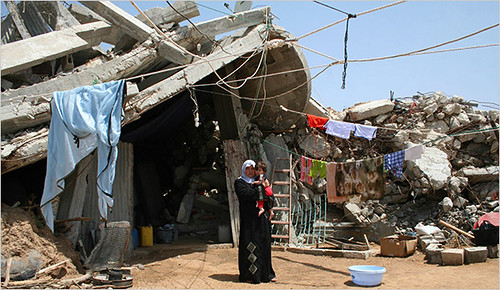
Also, the LA Times mentioned it briefly here. So, we are off an running!  More later. 

Monday, March 23, 2009

Tunnelizing Migration 3: From Headwalls to Super Walls


[Image: An unrelated photo, via DJ_Scamper.]

It looks like the U.S. government is running a little back-to-basics sort of test in the nation’s backyard along the Arizona-Mexico border. They’ve selected a key 100-yard stretch of space right alongside the fence in Nogales to pack a concrete “headwall” 10-12 feet deep, 1-2 feet wide into the ground that will form essentially an invisible extension of the border fence below the surface.

According to the article, the headwall was poured “where smugglers have made several attempts over the years to dig through to the United States.” The Border Patrol accompanied Mexican officials along the wash that runs parallel to International Street in Mexico where they get through “along a stretch that is covered by concrete.”


[Image: A photo of the headwall in Nogales, Az. as it is being poured.]

So, they have turned to yet another wall in attempt to cut off the shallow subterrain of this popular stretch, but – will it succeed? In my measly opinion more than likely it will for a short term anyway, but not because of the new "headwall" but rather all the extra attention the area is receiving in general right now so that more likely the cartel will shift their operation elsewhere, at least until the Border Patrol looks away again. Yet, no doubt the BP will attribute credit to the headwall for suppressing the number of tunnels found there in the future, and use it as ammunition to clone the strategy elsewhere, who knows perhaps even as far away as Gaza (more on that later). In fact, merely weeks after the concrete has dried, the Border Patrol is already claiming it a success, saying so far they haven’t found any new tunnels. Ha! Hilarious – it’s only been a few weeks!

I would be even less surprised if in a few more weeks from now they found a new tunnel stretching below, or even right through it.
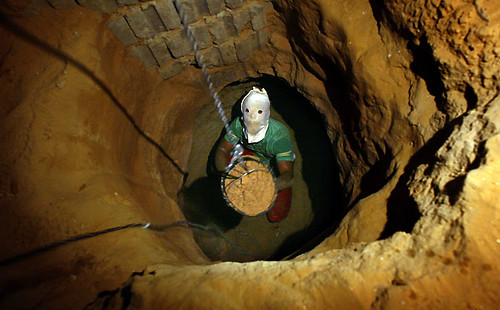

[Image: A photo of the headwall in Nogales, Az. as it is being poured.]

From what I’ve read in the past tunnelers have been known to reuse the concrete from the Customs and Border Protection’s plugs in order to support new passages. Often just offshoots of old existing tunnels, the BP will tell you, some of which are kept semi in tact like pregnant voids cut off inside the border at both ends; concretized air bubbles trapped below the earth’s surface. I also read a while back that to counter this move they were developing a special concrete that would crumble if tampered with, and using slurry so the plugs might cave in on tunnelers as well.

Yet, in trying to look at this from the DHS's perspective, my first reaction to an underground wall is: won’t this also just help the tunnelers by feeding them added raw material to work with? And wouldn’t it provide additional cover from other detection methods – especially if they’ve already been successful puncturing concrete?

Of course, the obvious lesson to me here is, you don’t solve the inherent fallacy of a wall by adding more walls. But, if there is one thing we can say about American policy in this regard, it is the kind of hardheadedness that perhaps only a headwall can do justice.

All I can say is, mustn’t underestimate the ingenuity of the cartel, or even the noble migrant seeking access to a better livelihood, for that matter. Now that it’s getting down to pitching shovels the size of football fields into the crawl spaces of the earth’s crust, what next? How deep do they plan for their underground wall to go?

• • •

In an unapologetically farcical portrayal of a future here, this roughly 3500 sq. ft. concrete headwall would only mark the tip of an iceberg – in reality, the tip of an impossibly extended manmade iceberg, since this headwall would be the first of many concrete sheets just like it to follow in its footsteps and be fed into the earth, numbered and mapped like an impenetrable storage system made for filing walls into the border. All part of an international project the leaders of global defense one day sought to supplant, in key locations at first – “an intelligent super wall” (as it had once been called) that would be built entirely underground (yes, underground), as a kind of sepulcherous megastructure; an anti cross-border tunnel fence, in more mundane terms, delineating national boundaries somewhat in secret along a deceptively hardened equator that would be (and get this) capable in its final stages of production of “shuffling giant reinforced concrete panels around inside the earth on hydraulics, magnets, and flexible tracks that would build itself like a web.” Apparently, at the behest of some nifty software it would also “constantly dig and recede deeper into the earth” below Hades’ own horizons where even “the roguest of rogue engineers working for the cartel would never be able to dig.”


[Image: A photo from Dubai.]

At the annual meeting of the 46th World Futurological Congress that took place inside an old half-built luxury condo tower that had been surgically dismantled on an abandoned site in Dubai, trucked and shipped in elephantine parts overseas to a small town outside of Nogales that was recently renamed Moho Vista, where the old condo’s side walls fifteen stories long and decapitated roof had been lifted by a new German breed of walking cranes and submerged vertically underground into these massive gills the Army Corps of Engineers spent months excavating right beside the border fence, the leading thinkers on global security had come together to observe what was formally ordained the first observational bunker for the work and testing being done on this new Great Wall project, that had not received much of anyone’s attention up to this point.


[Image: A photo from Dubai.]

It was here inside the architectural refuse of Dubai’s cosmopolitan ruins sunken in the ground where some of the dirtiest martinis were still served with napkins that had a cryptic drill-bit for a logo you could have easily mistaken for a mutant stingray or a flat-nosed hard-on of some kind militarized with earth crushing teeth, the chief heads of defense staff and their robotic secretaries had been sent to see firsthand how such a subterranean super wall might actually work towards helping to alleviate the persistent political aches of unsecured borders routinely taken over by highly sophisticated criminal elements.

As they wandered around inside the desiccated wet dreams of a far-off real estate mogul from a short past whose project had finally been relieved of its costly futility by way of burial now, the eyes and ears of the Congress were completely stunned to see the meticulous inner workings of this embedded laboratory which surprisingly only required a staff of 22 people to operate with optimal efficiency, where the hulks of busted buildings lay in wait on the surface in a storage yard for the next phase of assembly line to take hold and deliver them into an incredible handling system through landscape cuts and sculpted fissures held together by what looked like the brilliant network of diseased steel tracks and magnetic clasps moving on hydraulic spokes that might have even made Lebbeus Woods cringe with amazement.


[Image: The wall of the Bosnia Free State, by Lebbeus Woods.]

It was the greatest disappearing act you’d ever see – entire building broken down and swallowed by the earth. It had the simplicity of an IKEA living room lighting system that could be situated in various locations by gliding easily in any directions on a set of crisscrossed wires similar to the NFL’s silky smooth SkyCam, and the incomprehensible wonder and logic of a vortexual system that couldn’t be fully grasped visually because all of its parts at once seemed simply overwhelming. It looked like it had been designed to install panels the size of football fields or sidewalk squares depending on the need.


[Image: An unrelated construction photo.]

What they saw were the first rooted machinations of “a self-mining self-organizing wall-works system” that would allow just a handful of engineers to “feed in recycled slab and scavenged structural parts at ground level like cd’s into a multidisc player” before being conjoined again “in Tetris-like fashion” to create a new kind of barrier no one has ever seen before. The system was already performing some basic shuffling patterns pulling from a daisy chain of dislocated walls of various sizes and shapes accessed from a meticulously well-wired and imperceptibly long cavernous vault underground. It was kind of like mining a giant jukebox into the earth that swapped massive records of concrete underground instead of old vinyl by your table. The system kept exact measurements of all the sectional dimensions and weights before they were inserted so that each one (as it were) could be selected and appropriately fitted into specific excavated niches based on the spatial allowances the drilling machines were able to negotiate at the time.

In the project’s brochure the ‘observational bunker’ was pictured as being mobile and able to traverse along the wall in all directions on its own set of cables like an architectural labyrinthine spider. In some smaller renderings it was shown perched at a generic set of coordinates to inspect “unintended” gaps and maintain infrastructure, while in another image the engineers were using the sampled condo bunker to reach a clandestine tunnel they were plugging with some sort of indestructible mesh and concrete.

It was an incredible vision and the Congress was speechless watching gargantuan walls shifting in and out of place on an ingeniously compact frame that was fitted and secured with exceptional robotic engineering, while great booring snake heads chewed deeper into the earth below preparing for the next tectonic shifts in the wall’s invisible expansion. The underground wall would be able to maneuver itself down to depths of several hundred feet the first year, the Congress was told, they were going slowly to be safe, led by a set of smaller more durable panels that would slide down first behind the drills with every new depth change, “so the larger panels could slowly move down in their place.” It was a domino effect of walls falling into the earth, fastening and securing themselves into a kind of subtopic belt.


[Image: A photo from Dubai.]

In fact, after a brilliant briefing by a squirrelly planner named Chip who worked for a private agency chosen to lead the new Tectonic Warfare Task Force, who showed off what at first appeared completely laughable proposals for ways his demolition crews could not only scavenge but largely repurpose several different types of structural remains littering the world from shopping malls, substations and power plants to warehouses, abandoned railway tunnels and decrepit prisons, the Congress voted overwhelmingly in favor of funding the next phase of the project and leapt at the idea of using the Underground Wall to spur a new industrial boom that would capitalize not on building per se, so much as on hyping a responsible deconstruction of society’s decommissioned ruins, by breaking them down into valuable fortification materials, and relocating them deep inside the contentious seams of regional border zones where a “chain of superficial perforations” would be dug and the underground panels could be distributed to their new positions safeguarding the wealthy nations from below.

It was a mouthful. And, “it was like treating the earth for cavities,” Chip said, “we see ourselves as large scale dentists in this great endeavor, attacking the criminal tunnel networks where they’re known to exist or are still considered likely before they spread.” And he was creating a kind of cemetery to late capitalism in the process, helping to dispose of the urban shells left in the economy’s deflated wake. And right towards the end of his briefing, just to give the Congress that extra thump over the head he said, “Oh, and a combination of the wall’s flexibility afforded by our innovative mesh and the ability to fasten the whole thing on revolutionary new vibration dampeners will allow each separate structure to independently absorb and adjust to the earth’s routine shifts and movements. So, in case you were wondering,” the planner assured them, “earthquakes are our friends. They actually help tighten the wall’s pieces together.”


[Image: An unrelated photo.]

For the time being he had dodged any questions about whether slicing the earth’s crust in half might actually cause any earthquakes, and quickly handed out business cards on a translucent paper to everyone while shaking hands and generally feeling like an underground rockstar.

On paper, it was a marvelous feat of military engineering that imagined an infinite concrete wall stretching and sinking as if it were its own tectonic plate sliding along a seismically reinforced axis that would shut the curtain on the underground forever to come, which had brought everyone on board from national security experts to mining gurus, real estate speculators and engineers, global steel companies, private prison operators, geography professors and their gangly grad students, hordes of environmental activists with telescopes and loudspeakers, Native American spiritual leaders, corporate lobbyists, hard headed politicians, conspiracy tweaks, conmen and madmen, all the way down to the average Joe construction worker – they all wanted a piece of this new subterranean boom and in some strange way it had a place for each and every one of them. There was no one who wasn’t curious enough to go see this thing for himself from as close as he could get once word broke out the U.S. was stashing old buildings below the border for some sort of national security project. It wouldn’t be long before small armies of RV’s would turn up dotting ridges and pooling in valleys to launch their cell phone based tourist maps of the restricted areas.

Securing the Homeland to the Core became a kind of generic mantra over time that ended up printed on thousands of coffee mugs in cubicles worldwide, on T-shirts and for for sale on Ebay, on new and strange product packaging which soon emerged from all of this: weird energy drinks that supposedly increased the health of your pupils, flavored oxygen inhalers, glow in the dark bubble gums. Tunnel rat junk foods.

The idea, though, that globalization’s extinct structures could be recompiled into a new Great Anti-Tunnel Wall underground “to put organized crime back in its place,” was simply too mouth-watering for the participants of the Futurological Congress to disapprove.


[Image: A photo of the headwall in Nogales, Az. as it is being poured.]

Hailed as “the answer” to groups of “international outlaws” and “cowardly terrorists” who have “taken refuge under our borders for far too long,” in the end the planner had sold the leaders of the world on the simple concept of a titanic barrier sinking towards the bottom of the earth, defying geological convention, spreading horizontally like thieving waves that would remain permanently just under the surface to stem the tunnely platitudes and seamy sanctuaries of the violent and rapacious cartel.

And just as security bureaucrats had given into the incontrovertible reality of the border fence having miserably failed as a consequence to “illegal immigration,” this new plan was set to revive their hopes all over again and redeem what had seemed irredeemable to the public who spent billions already on the legacy of a juvenile and ill-fated strategy for years. This time the border fence would do what it was meant to do, they said, this was the most formidable security structure ever conceived or ever built, and it was going to be a complete and total future archaeological wonder of the world one day that had already brought the Pentagon to its knees upon seeing walls fed into the earth as easy as a giant toaster, who signed off on it even before the precautious little planner had to ask if there were any questions. The postcards had already been sent to the printer. There was no way this thing could lose, was the caption that hung over everyone’s head that afternoon walking out of there.

Of course, how it all turned out, was, well, a different story, as you might imagine.

Part 4 coming soon. Oh, so is part 2.

Read: Tunnelizing Migration 1: The Border Tunnel Capital of North America
Video: Walls beget tunnels and tunnels beget walls